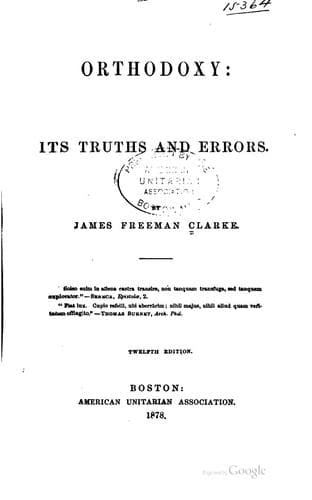
Orthodoxy: Its Truths And ErrorsClarke, James Freeman
Religion
Orthodoxy: Its Truths And Errors
Clarke, James Freeman
Unitarianism
Consider, again, what is said on this subject in the Epistles. “Jesus
Christ, whom God hath set forth as a mercy seat through faith in his
blood.” “When we were enemies we were reconciled to God by the death of
his Son.” “He died for our sins.” “He is sacrificed for us.” “He gave
himself for our sins.” “We have redemption through his blood, even the
forgiveness of sin.” “Having made peace through the blood of his cross.”
“He gave himself a ransom for all.” “He washed us from our sins through
his blood.” “By whose stripes we are healed.” “Though he were a Son, yet
learned he obedience by the things which he suffered, and being made
perfect, became the author of eternal salvation unto all them that obey
him.” Again: “But we see Jesus, who was made a little lower than the
angels, for the suffering of death, crowned with glory and honor, that he,
by the grace of God, should taste death for every man. For it became him,
for whom are all things, and by whom are all things, in bringing many sons
unto glory, to make the Captain of their salvation perfect through
sufferings.” “Wherefore in all things it behooved him to be made like unto
his brethren, that he might be a merciful and faithful high priest in
things pertaining to God, to make reconciliation for the sins of the
people. For in that he himself hath suffered, being tempted, he is able to
succor them that are tempted.”
These are some of the passages which connect the sufferings of Jesus
Christ with sin on the one hand, and salvation on the other.
§ 4. Difficulty in interpreting these Scripture Passages.
There is a difficulty, however, in understanding the meaning and feeling
the force of such texts as these. This difficulty consists in the fact
that these passages are constantly quoted as proof texts. From our
childhood up we have heard them brought forward to prove the truth of some
particular doctrine or theory of atonement, and when we read these verses,
we immediately associate them with some doctrine which we like or dislike.
Our feelings and prejudices are involved in interpreting the passage one
way or the other, so that we are unable to look at it fairly. In order to
overcome this difficulty, we must make this obvious distinction. We must
distinguish between the statement of a fact and the theory concerning it.
The fact which the Bible states is simply this—that the sins of man were
the occasion of Christ’s death, and that by his death he saves us from our
sin. This is the fact which the Scriptures assert. The way in which he
saves us is a matter of theory. Why it was that human sin made it
necessary for Christ to die, how it is that his death reconciles us to
God,—this belongs to the theory.
Now, while the Scriptures say a great deal about the fact that Christ’s
sufferings save us from our sins, they say very little as regards the way
in which they save us from our sins.
§ 5. Theological Theories based on the Figurative Language of the New
Testament.
Public-domain text, read in full here on John Shaqi.
Reviews
Reviews
No reviews yet
Be the first to share your thoughts on this work.
Elsewhere in the archive
Join the Discussion
Join the discussion
Sign in to leave a comment or review.
Sign InorCreate an account