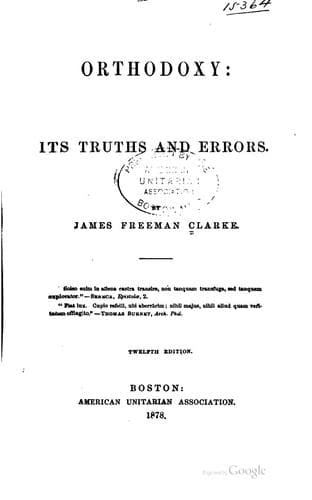
Orthodoxy: Its Truths And ErrorsClarke, James Freeman
Religion
Orthodoxy: Its Truths And Errors
Clarke, James Freeman
Unitarianism
The Scriptures state the fact; the theologians have supplied the
explanations. Innumerable have been the theories devised by theology to
show in what way the sufferings of Christ have availed for the salvation
of men—theories of imputation, theories of substitution, theories of
satisfaction. He was punished in our place; he paid our debt; he was our
federal head and representative; he satisfied the justice of God; he
appeased the wrath of God. But especially are the figures and metaphors of
the New Testament pressed into the service of theology, and made the basis
of grave theories. Thus are metaphors turned into metaphysics, and
rhetoric changed to logic. The images of the New Testament were naturally
taken from familiar objects and transactions, especially from war, from
slavery, and from the Jewish ritual. Sin is our enemy, who has conquered
us in battle, and made us his prisoners. Christ redeems us from this
captivity, and pays our ransom. Sin is a cruel master, and we are his
slaves. He is about to torture us with the rod. Christ comes and takes our
punishment on himself. He bears our stripes. According to the Jewish
ritual the paschal feast was a commemoration of God’s mercy. It was to the
Jews what Thanksgiving Day is to the people of New England. So the
Christians said Christ is our Passover. In the Jewish ritual God was
believed to manifest himself over the mercy seat in the inner sanctuary of
the temple. The Christians said, Christ is our mercy seat. All this was
natural; but these images have been turned into elaborate theories by the
theologians who have argued that Christ’s death was a literal ransom, a
literal mercy seat, and a literal passover.
These theories have mostly passed by. The common Orthodox theory in New
England now is much more reasonable, but unfortunately much less
scriptural. It is founded on the analogy of human government. God is
compared to a wise and kind ruler, who governs by law, and who wishes to
pardon the penitent criminal, but fears that if he does so, he will impair
the respect felt for his law, and therefore thinks it necessary to do
something to show the evil of disobedience before he can pardon. Christ is
willing to die in order to make this impression on the minds of men. And
this he accordingly does. But unfortunately, as we said, there is nothing
in the Scripture, not even a metaphorical expression, to support this
theory. The apostles did not have recourse for their figures and images to
such usage of government, and that for the simple reason that no such
usage or necessity then existed. The governments were all despotic, and no
despot, wishing to pardon, had any difficulty on the ground that the
sanctity of his laws might be impaired.
War, slavery, and the Jewish ritual, and household usages existed. Their
images were taken from these. They spoke of ransom, of stripes, of the
passover, and the mercy seat, of washing and healing, but not of
governments and laws.
Public-domain text, read in full here on John Shaqi.
Reviews
Reviews
No reviews yet
Be the first to share your thoughts on this work.
Elsewhere in the archive
Join the Discussion
Join the discussion
Sign in to leave a comment or review.
Sign InorCreate an account