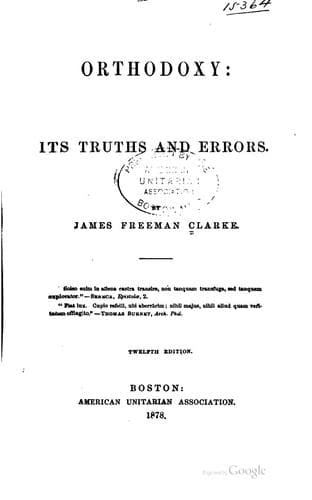
Orthodoxy: Its Truths And ErrorsClarke, James Freeman
Religion
Orthodoxy: Its Truths And Errors
Clarke, James Freeman
Unitarianism
To illustrate all this, let us suppose a case. A man, hitherto respected
and trusted by society commits some great breach of trust, and robs the
community. What does the conscience in such a case demand? First, that he
should give up his property, and make, if he can, full restitution;
second, that he should endure some suffering—that he should not continue
to enjoy, as before, all his accustomed privileges; and third, that he
should not retain his standing in society, and receive, as before, the
countenance and esteem of honorable persons. Conscience requires that he
should make atonement to those he has injured by restitution; to the law
of right, which he has offended, by suffering some punishment; and to
honorable men by keeping out of their way.
This, which the conscience teaches of an injury done to man, it also
teaches of an injury done to God. The offence against man is _a crime_;
the offence against God is _a sin_. For a crime, the conscience requires
restitution, punishment with confession, and alienation from the good,
which is shame. For a sin, the conscience requires, in like manner,
restitution, punishment, and alienation. It merely transfers to God’s
justice the ideas of atonement which human justice has given to it.
But God’s justice is not like man’s. The ideas of atonement so abstracted
are essentially false; and to convince us of their falsehood is one of the
objects of Christ’s death. It is to show us that God does _not_ demand
this full restitution, does _not_ intend to inflict this punishment, and
is _not_ alienated from the penitent sinner. The death of Christ has done
this.
§ 10. How the Death of Jesus brings Men to God.
As a matter of fact, the death of Christ has enabled men to come to God.
“They who were afar off are made nigh by the blood of Christ.” As a matter
of fact, it has lifted men above the fear of God into the love of God. And
this must be a divine work. Not the mere death of the human being could
have done this; but the God who dwelt in him has uttered his tender love,
his forgiving grace, from the cross. “God was in Christ, reconciling the
world unto himself.” The death of Christ is an expression of God’s free
grace. If we regard Christ, in his life and character, as a manifestation
of God’s will, then his pathetic and tender death reveals to us that God
loves us even when we are sinners, before reparation or repentance; “for,
while we were sinners, Christ died for us.”
There is, however, a difficulty in _believing_ that we can be forgiven.
This difficulty is in the conscience; and,—
(_a._) To say _there is no difficulty_, will not remove it.
(_b._) To say that _repentance and good works_ are enough, will not remove
it.
(_c._) To say that _God is merciful_, will not remove it; for the
difficulty lies in the _conscience_, which declares that every sin is,—
1. An injury done to God.
2. An injury to the moral universe; inasmuch as it is an example of evil,
and a defiance of right.
Public-domain text, read in full here on John Shaqi.
Reviews
Reviews
No reviews yet
Be the first to share your thoughts on this work.
Elsewhere in the archive
Join the Discussion
Join the discussion
Sign in to leave a comment or review.
Sign InorCreate an account