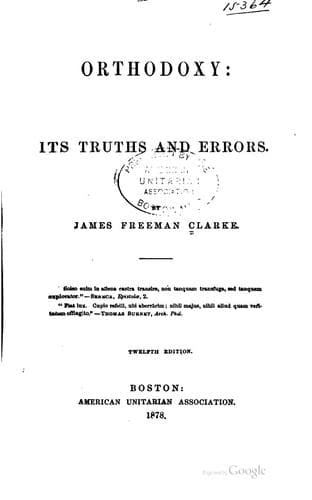
Orthodoxy: Its Truths And ErrorsClarke, James Freeman
Religion
Orthodoxy: Its Truths And Errors
Clarke, James Freeman
Unitarianism
The central idea of the atonement is, that Christ has done something which
enables God to forgive us our sin; and the reason why this doctrine of
atonement seems so precious is, that we feel that there is a real
difficulty in the way of forgiveness,—as if something else were necessary
besides repentance,—as if some compensation or reparation should be made
somehow to the offended law of God, or to the aggrieved holiness of God.
We do not say that this feeling is a true feeling: that question we must
consider afterwards. But it is, at any rate, a natural feeling, whether it
be founded on our knowledge of God or our ignorance of God. It is hard to
believe that a _man_ whom we have injured will forgive us that injury
merely because we ask him to do so, and are sorry for what we have done.
We feel that we must make some reparation before he can or ought to
forgive us. Unquestionably, the conscience is the source of this feeling.
It led Zaccheus to say, “If I have done any man wrong, I restore him
four-fold.” A full reparation for an injury, accompanied with sorrow for
having done it, the expression of which sorrow is confession, satisfies
the conscience. Having done this, we feel that we have a right to be
forgiven.
But it is very seldom that such full reparation can be made. The
consequences of our wrong acts cannot usually be removed or effaced.
Wrong-doing is like the gate of hell—easy to open, but difficult, if not
impossible, to close again. “She opened, _but to shut_ excelled her
power.” Instead of reparation, therefore, the conscience substitutes
retribution—either reparation or the penalty; and the natural form of the
penalty is an equivalent. Natural justice says, “An eye for an eye, a
tooth for a tooth.” This the conscience thinks right; this is justice. All
less than this is mercy; all more than this is revenge.
We think that if we analyze the feeling which the conscience gives us
concerning the consequences of wrong-doing, it is this: First, conscience
demands reparation to the injured party; second, it demands punishment as
a satisfaction to be made to the law of right, and this suffering to be
accepted as just by the guilty party; and thirdly, it declares that guilt
should produce an alienation or separation between the guilty party and
those who are not guilty.
Public-domain text, read in full here on John Shaqi.
Reviews
Reviews
No reviews yet
Be the first to share your thoughts on this work.
Elsewhere in the archive
Join the Discussion
Join the discussion
Sign in to leave a comment or review.
Sign InorCreate an account