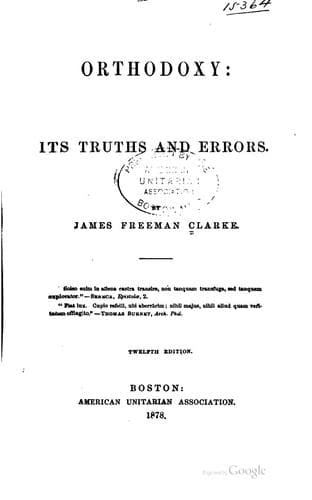
Orthodoxy: Its Truths And ErrorsClarke, James Freeman
Religion
Orthodoxy: Its Truths And Errors
Clarke, James Freeman
Unitarianism
Then, as to the _injury to the world_ by the contempt sin does to the law,
the sufferings of Christ are _satisfaction_: they satisfy the divine law;
they make an impression of the importance of the law. But here, again, it
is not merely Christ alone who does it, but God in Christ, and Christ in
the Church, who honor the divine law by the respect produced for it. They
bring us to repentance; they make us feel the sinfulness of sin; show us
the misery it causes to those who love us,—how it pains God, pains Christ,
pains the good, and pains our friends. So we feel it, and show it by true
penitence, and so honor the law. The law is _satisfied_ when the
sufferings of Christ and his followers, caused by sin, lead men to abhor
sin, and love righteousness.
As to the injury which _sin does to a man himself_ by separating him from
God’s love, and making him at enmity with God, and God’s wrath on him, the
sufferings of Christ are _reconciliation_. “God was in Christ, reconciling
the world to himself.” Why was God alienated from man? Because he is holy.
How can an unholy person be at one with a holy God? The answer is this:
God comes into his heart by Christ, to form Christ within him, and to make
him holy as Christ was holy. He sees that when united with Christ his
sinfulness is killed in its roots, and a seed of perfect purity is planted
in his soul; and so God is able to be at one with him through his union
with Christ: “I in them, and thou in me, that we may be perfectly at one.”
A love for Christ in the heart forms Christ within us. He is our life, our
motive power, our aim; and so he casts out the root of our sin, and brings
us to God.
Thus we see that, even though we should reject all the Orthodox theories
about atonement, we may accept the fact. We can believe that God in Christ
_does_ reconcile the world to himself,—_does_ create a sense of pardoned
sin,—_does_ remove the weight of transgression,—_does_ take away the
obstacle in our conscience,—_does_ help us into a living faith, hope,
peace, and joy.
Moreover, Christ is really a sacrifice for sin—a real and true
sin-offering. For what were the sin-offerings under the law? How did they
remove sin? Not by themselves (it was impossible for the blood of bulls
and goats to remove sin), but because they were an appointment of God, and
so showed God’s disposition. They showed that his holiness was displeased
with evil; they showed that he loved the sinner, and wished to make him
holy. So the death of Christ is a true sacrifice in exactly the same way,
but in a higher degree, convincing us of the evil of sin and the love of
God.
Public-domain text, read in full here on John Shaqi.
Reviews
Reviews
No reviews yet
Be the first to share your thoughts on this work.
Elsewhere in the archive
Join the Discussion
Join the discussion
Sign in to leave a comment or review.
Sign InorCreate an account