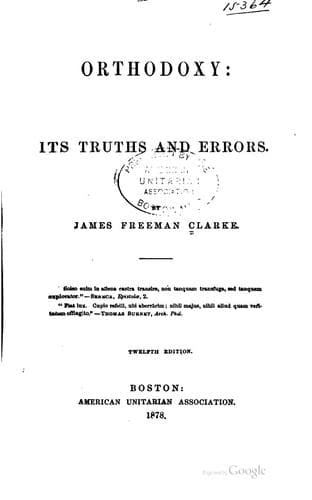
Orthodoxy: Its Truths And ErrorsClarke, James Freeman
Religion
Orthodoxy: Its Truths And Errors
Clarke, James Freeman
Unitarianism
The experience of the whole Church teaches the power of this faith to
create in our souls a new life of love. Seeing God coming to us in Christ
to reconcile us to himself, and freely forgiving our sins, removes from
our hearts doubt, anxiety, and the burden of hard responsibility, and
fills the soul with a deep peace and joy in believing. So felt the apostle
Peter when the Master forgave him his denial. From the fountain of that
forgiveness flowed forth a river of devotion. So felt Paul when forgiven
by Jesus; so felt Augustine, so Ambrose, so Luther, so Wesley: because
they had been forgiven much, they loved much; for to whom little is
forgiven, the same loveth little.
The practical conclusion is, that it is less important to speculate as to
the _how_, than to endeavor to see the fact. What we need is faith in
God’s pardoning, redeeming, saving love in Christ Jesus—faith that our
sins are blotted out; that we can come at once to our Father; that we can
come boldly to the throne of grace; that the infinite Father looks at us
with love when we are a great way off, and says, “This my son was dead,
and is alive again; was lost, and is found.”
We may therefore, when we are conscious of going wrong and of doing wrong,
instead of trying to reform ourselves alone by our own strength, go first
to God, and be forgiven through faith in the great sacrifice of Christ:
“When God hath set forth to be a propitiation (or mercy seat), through
faith in his blood, to declare his righteousness for the remission of sins
that are past, through the forbearance of God, that he might be just, and
the justifier of him which believeth in Jesus.”
§ 11. This Law of Vicarious Suffering universal.
Orthodoxy, in all its theories concerning the influence of the death of
Jesus, has supposed his case exceptional and his work peculiar. It would
be very shocking to most Orthodox minds to suppose that the same law of
vicarious sacrifice applies to others; that the sufferings and death of
the good, in all ages, have helped to atone for evil; have enabled sinners
to obtain pardon. But such, we believe, is the fact.
Public-domain text, read in full here on John Shaqi.
Reviews
Reviews
No reviews yet
Be the first to share your thoughts on this work.
Elsewhere in the archive
Join the Discussion
Join the discussion
Sign in to leave a comment or review.
Sign InorCreate an account