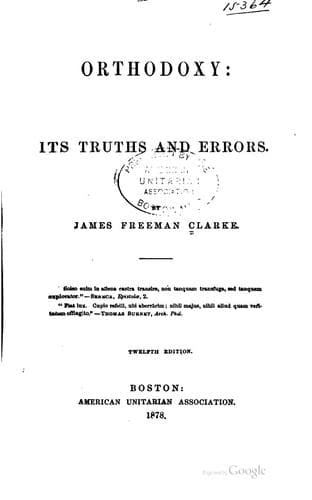
Orthodoxy: Its Truths And ErrorsClarke, James Freeman
Religion
Orthodoxy: Its Truths And Errors
Clarke, James Freeman
Unitarianism
Jesus Christ came, providentially, as the typical and perfect man—the one
who was sent by God, in his providence, to illustrate what humanity is to
be and to do. If this is so, then Christ did essentially nothing but that
which is finally to be done by _all_, in some degree, or some way. He is a
channel, a mediator, through whom God’s life flows into ours; but then he
makes us also mediators, by whom _his_ life shall flow to others. He is
the image of God; but every true Christian is, again, the image of Christ.
For what Christ did, and was, was no afterthought, no exception, but a
part of the plan of the universe. He was “foreordained before the
foundation of the world, but manifest in these last times.” He was the
“Lamb of God, slain from the foundation of the world.” That is, his
coming, his character, his death, his resurrection, his miracles, were all
a part of a divine law. And all God’s laws are the same “yesterday,
to-day, and forever.”
If this were not so, we could not understand Christ, nor sympathize with
him. His life would be, not only supernatural, which it is, but unnatural,
which it is not. His miracles would be, not what they truly are,—God’s
higher life flowing into nature, and the Spirit overcoming the material
resistance of things,—but they would be magical; they would be like
sorcery and enchantment—violations of the course of events.
All of Christ’s life, then, is typical of our future lives, in this world
or in some other world. It would be easy to prove this out of Scripture.
Everything asserted of Christ is, somewhere and in some way, asserted also
of his disciples, and of all Christians. Is he said to be one with God? “I
and my Father are one.” They also are said to be one with God: “That they
all may be one, as we are one; I in them, and thou in me. As thou, Father,
art in me, and I in thee, that they also may be one in us.”
Was Christ said to know all things? It is also said of his disciples, “Ye
have an unction from the Holy Ghost, and know all things.”
Did Christ work miracles? He says to his disciples, “Greater works than
these shall ye do?”
Did God give to Christ glory which he had before the world was? He himself
says of his disciples, “The glory thou gavest me I have given them.”
Did Christ rise from the dead into a higher life? We shall do the same.
“As we have borne the image of the earthly, we shall also bear the image
of the heavenly.”
Christ, in his high and perfect life, may be regarded as a prophecy of
what man is to become: we may look on him as a revelation of the higher
laws of human nature, as a type of all humanity.
Public-domain text, read in full here on John Shaqi.
Reviews
Reviews
No reviews yet
Be the first to share your thoughts on this work.
Elsewhere in the archive
Join the Discussion
Join the discussion
Sign in to leave a comment or review.
Sign InorCreate an account