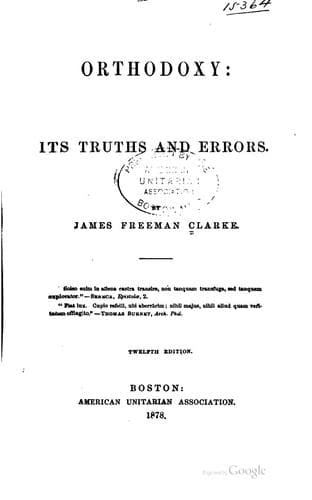
Orthodoxy: Its Truths And ErrorsClarke, James Freeman
Religion
Orthodoxy: Its Truths And Errors
Clarke, James Freeman
Unitarianism
They asked why she let the people kiss her feet and garments. She
answered, “The poor people came to me because I did them no wrong, and
helped them when I could.” “Was it well to attack Paris on Our Lady’s
day?” “It is well to keep the festivals of Our Lady always.” “Do your
saints love the English?” “They love what God loves, and hate what he
hates.” “Does God hate the English?” “As to his love or hate for their
souls I know nothing; but I know he will drive them from France.” “Can you
tell whether you will escape death?” “That I leave in God’s hands.” When
she went to death, her purity and truth had so touched men’s hearts that a
great tide of remorse and pity began to swell up against her persecutors.
A priest, who had played the part of Judas, and betrayed her, repented
like Judas, and flung himself down before her, accusing himself of his
treachery. The soldiers who stood by were melted. They said, “We have
burned a saint.” The executioner declared that God would never forgive
him. From the day of her death, all men began to believe in her holiness
and truth.
Come down to the end of the same century, and take another instance in
Savonarola, the Florentine friar—the man who was at once the patriot,
leading the minds of the people of Florence to republican institutions;
the reformer, seeking to root out the abuses of the Church; and the
prophetic teacher, preacher, religious inspirer. He also climbed to the
height of his glory on his funeral pile. As Athens was glorified by the
death of Socrates, as the Maid of Orleans has been a vision of beauty in
the square of Rouen, so the place in Florence where Savonarola was
murdered, in front of the Palazzo Vecchio, is memorable as the scene of
virtue triumphing over its enemies and over evil, when it seemed to be
conquered. That day, also, will never be forgotten, when he and his two
companions walked through the furious rabble to their death, calm as if to
a marriage feast. Savonarola was so absorbed in the thought of the life to
come, says his biographer, that he appeared already to have left the
earth. He was put to death by the order of Alexander Sixth, the worst pope
and worst man of modern times; but in twenty years Rafaelle was painting
the monk’s portrait on the walls of the Vatican by order of another pope.
So it is that death glorifies life. If John Brown had escaped from his
prison, and gone to Canada, what would have been his influence? He would
only have been remembered as a crazy fanatic. But now there remains in all
minds the picture of the old man going quietly and peacefully to die,
kissing the little negro child on the way, looking up at the surrounding
hills, and admiring the beauty of the scenery. Death set its seal on his
life, and so his soul became the leader of the armies of the Union, going
before them to victory.
Public-domain text, read in full here on John Shaqi.
Reviews
Reviews
No reviews yet
Be the first to share your thoughts on this work.
Elsewhere in the archive
Join the Discussion
Join the discussion
Sign in to leave a comment or review.
Sign InorCreate an account