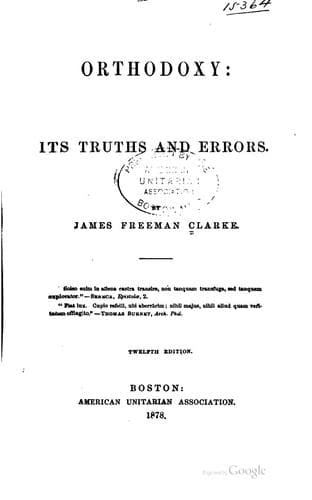
Orthodoxy: Its Truths And ErrorsClarke, James Freeman
Religion
Orthodoxy: Its Truths And Errors
Clarke, James Freeman
Unitarianism
And how much, also, was Abraham Lincoln glorified by his martyr death! How
he rose at once into a great figure in history—a monumental form before
which enmity was silenced! All men forgot their hostility, their
criticisms, their sneers—forgot that they had ever done anything but honor
him. The assassin, who thought to revenge the wrongs of the southern
slaveholders on Lincoln, gave to him a lasting niche in the temple of
fame.
Now, we are not by any means _comparing_ the work of these persons with
that of our great Master, Jesus Christ. Such is not our object. We are
only pointing out the law by which a person who has devoted himself to a
great cause, when he comes to die in its service, gives to that cause an
immense help, and seems to sanctify and glorify the cause and himself.
There is a mystery about it which we do not fully understand,—which is not
accounted for by saying that death proves a man’s sincerity, and makes him
a more competent witness, or that death conciliates his enemies, and puts
an end to personal dislike. No; there is something more than this. When
men live for a cause outside of themselves, when they labor for public
objects, they are not _seen_ while they live. Those whose interests are
interfered with by their action, misrepresent them, and surround them with
a cloud of suspicion, jealousy, and slander. When they go to death for
their cause, all these slanderous voices are hushed, and they emerge from
this cloud of prejudice, and are seen as they are. They are glorified then
in their cause, and their cause is glorified in them. The cause for which
Socrates lived was the education of the people of Athens to truth and
justice. All the Sophists were his enemies. Aristophanes ridiculed him as
no other reformer has ever been ridiculed, holding him up, by his
inimitable wit, to the scorn of the crowded theatre. When he died, and
died in the faith, all this ended. Socrates and his great cause of justice
rose at once, and drew all men to them. So Savonarola, who lived only with
the purpose of helping on the triumph of pure religion in the Church, and
pure liberty in the state, was mocked and abused in his life; but his
death made him an undying power, and being dead, he spoke across the rapid
years to Martin Luther and the reformers who came after. John Brown lived
and died for universal freedom; Abraham Lincoln lived and died for the
existence and deliverance of the nation. Of them, exactly as of Christ, we
may say that when they died the hour came for them to be glorified. They
died, and they rose again. The resurrection, in these instances, came
close after the crucifixion; not seen in their cases, as is that of Jesus,
by the visible eye, but essentially the same thing inwardly as his. They
and their cause went _up_, instead of going down, by their death. When
they were lifted up, they drew all men to them. In all such deaths, also,
there is a certain atoning, reconciling influence. Death brings together,
Public-domain text, read in full here on John Shaqi.
Reviews
Reviews
No reviews yet
Be the first to share your thoughts on this work.
Elsewhere in the archive
Join the Discussion
Join the discussion
Sign in to leave a comment or review.
Sign InorCreate an account