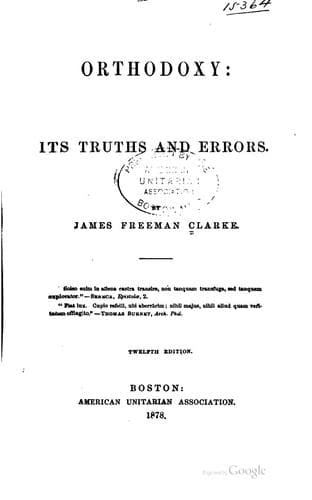
Orthodoxy: Its Truths And ErrorsClarke, James Freeman
Religion
Orthodoxy: Its Truths And Errors
Clarke, James Freeman
Unitarianism
We are persuaded that this is the right view. We are sure that one day we
shall all see that Christ’s sufferings and death, and their influence, are
as simple, as natural, as wholly in accordance with human nature, as that
of any other saint or martyr; that the difference is of degree, not of
kind; and Christ will go before the world, its great Redeemer and Leader,
all the more certainly because one of us,—educated, as we are, by trial
and sorrow; tempted as we are, but without sin; crying out, as we do, from
the depths of our despair, “My God! why hast thou forsaken me?” and
rising, as we do, through death to a higher life, through sorrow to a
completer joy, through the pains of earth to the glories of heaven. “For
it became him for whom are all things, and by whom are all things, in
bringing many sons unto glory, to make the Captain of their salvation
perfect through suffering; wherefore in all things it behooved him to be
made like unto his brethren, that he might be a merciful High Priest; for
in that he himself hath suffered, being tempted, he is able also to succor
those who are tempted. For we have not a High Priest who cannot be touched
with the feeling of our infirmities, BUT WAS IN ALL POINTS TEMPTED AS WE
ARE, yet without sin; who can have compassion on the ignorant, as he also
himself is compassed with infirmity, and though a Son, yet learned
obedience by the things he suffered.”
§ 14. Results of this Discussion.
The Orthodox doctrine of the atonement contains a fact and a theory which
ought to be carefully discriminated. _The fact_ asserted by Orthodoxy is,
that Jesus Christ has done something by means of which we obtain God’s
forgiveness for our sins. _The theory_ attempts to explain what is the
difficulty in the way of our forgiveness, and how Christ removes it. Thus
Orthodoxy attempts to answer three questions: “What?” “Why?” and “How?”
The first of these regards the fact. “_What_ has Christ done?” And the
answer is, that he has brought to man forgiveness of sin. The second and
third questions regard the theory. “_Why_ was it necessary for Christ to
do and suffer what he did?” and, “_How_ did he accomplish his work?”
Now, as concerns the matter of fact, Orthodoxy is in full accordance with
the Scriptures, which everywhere teach that through Christ we have
redemption, through his blood, even the forgiveness of our sins. But the
Scriptures are perfectly silent concerning the theory. They do not tell us
_why_ it was necessary for Jesus to die, nor _how_ his death procured
forgiveness. The only exception is, as we have seen, in the statement, in
the Epistle to the Hebrews, that the sufferings of Christ were necessary
to make him perfect, and to enable him to be touched with a feeling of our
infirmities.
Public-domain text, read in full here on John Shaqi.
Reviews
Reviews
No reviews yet
Be the first to share your thoughts on this work.
Elsewhere in the archive
Join the Discussion
Join the discussion
Sign in to leave a comment or review.
Sign InorCreate an account