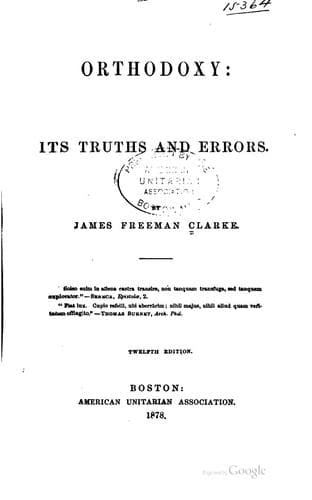
Orthodoxy: Its Truths And ErrorsClarke, James Freeman
Religion
Orthodoxy: Its Truths And Errors
Clarke, James Freeman
Unitarianism
Of the three theories which in turn have been regarded as Orthodox in the
Church, two have completely broken down, and the third rests on such an
insecure foundation that we may be very sure that it will follow the
others as soon as any better one comes to take its place. The warlike
theory and the legal theory of the atonement have gone to their place, and
are no more believed by men. The governmental theory must soon follow.
Nevertheless, in each of these three theories there is one constant
element. And it is due to Orthodoxy to state it. This element is, that the
necessity of the death of Christ lay in the divine attribute of justice.
According to the first theory, Christ died to satisfy what was due by God
to the Devil; according to the second, he died to satisfy what was due by
God to himself; according to the third, he died to satisfy what was due by
God to the moral universe. Divine justice, in the first theory, owed a
ransom to the Devil, which Christ paid; in the second, it owed a debt to
the divine honor, which Christ paid; in the third, it owed protection to
the universe from the danger of evil example.
The difficulty to be removed before God can forgive sin, lay, according to
all of these theories, in the divine justice. Christ died to reconcile
justice and mercy, so as to make justice merciful, and mercy just.
But, in opposition to this view, the Unitarian argument is so formidable
as to seem quite unanswerable. On grounds of reason, the Unitarian
maintains that there can be no such conflict among the divine attributes,
waiting till an event should occur in human history by which they should
be reconciled. That God’s justice and mercy should have been in a state of
antagonism down to A.M. 4034, when Jesus died, is an incredible
supposition. No event taking place in time and space can be the condition
_sine quâ non_ of divine perfection. And any struggle or conflict like
that supposed implies imperfection.
Moreover, the Unitarian truly maintains that the Orthodox theory that men
cannot be forgiven on the simple condition of repentance, is wholly
unscriptural. The Scriptures plainly teach that forgiveness follows
repentance. In the classic passage of the Old Testament (Ezek. 18:20-32),
the Jews were taught, unequivocally, that the death which is the wages of
sin, is always removed by the simple act of repentance. If the modern
doctrine of Orthodoxy be true, that in order to be saved it is necessary
not only to repent, but also to believe in the atoning sacrifice, the Jews
were fatally misled by this teaching of the prophet.
And so in the New Testament, the parable of the prodigal son teaches us
plainly that when we repent and return to God, we shall be received, and
that without any reference to belief in the atonement.
Public-domain text, read in full here on John Shaqi.
Reviews
Reviews
No reviews yet
Be the first to share your thoughts on this work.
Elsewhere in the archive
Join the Discussion
Join the discussion
Sign in to leave a comment or review.
Sign InorCreate an account