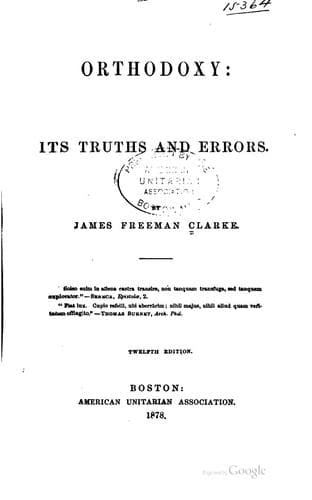
Orthodoxy: Its Truths And ErrorsClarke, James Freeman
Religion
Orthodoxy: Its Truths And Errors
Clarke, James Freeman
Unitarianism
This is the real difficulty. Christ did not die to pay a debt to God, or
to appease his wrath, but “to bring us to God,” and to put the Spirit into
our heart by which we can say, “Abba, Father!” The atonement is made to
the divine justice—but not to distributive justice, which rewards and
punishes, but to divine justice in its highest form, as holiness. And this
consists in making us fit to appear before God, notwithstanding our
sinfulness, because we have received a principle of holiness which will
ultimately cast out all our sin. When we have faith in Christ, we have
Christ formed within us, the hope of glory. God, looking on us, sees us
not as we are now, but as we shall be when we are changed into that same
image from glory to greater glory.
This suggests the theory which may replace the rest, and reconcile all
those who believe in Christ as the Saviour and Redeemer of men. Christ
saves us by pouring into us his own life, which is love. When Christian
love is formed within us, it has killed the roots of sin in the soul, and
fitted us to be forgiven, and to enter the presence of God.
In conclusion, we may say that Orthodoxy is right in maintaining that
Jesus has by his sufferings and death brought forgiveness to mankind—not
by propitiating God or appeasing his anger, not by paying our debt or
removing a difficulty in the divine mind, but by helping us to see that
the love of God is able to lift us out of our sin, and present us spotless
in the presence of his glory with exceeding joy. The way in which his
death produces this result is the sympathy with human sinfulness and
sorrow, which finds in it its highest expression. Those whom men cannot
forgive, and who cannot forgive themselves, see that God, speaking through
the sufferings of Jesus, is able to forgive them. So the love of God
brings them to repentance, and those who were afar off are made nigh by
the blood of Christ.
CHAPTER XI. CALLING, ELECTION, AND REPROBATION.
§ 1. Orthodox Doctrine.
The Assembly’s Catechism, with its usual frankness, states this doctrine
thus:—(chap. 3).
I. “God, from all eternity, did, by the most wise and holy counsel of his
own will, freely and unchangeably ordain whatsoever cometh to pass, yet so
that neither is God the author of sin, nor is violence offered to the will
of the creatures, nor is the liberty or contingency of second causes taken
away, but rather established.
II. “Although God knows whatsoever may or can come to pass upon all
supposed conditions, yet hath he not decreed anything because he foresaw
it as future, or as that which would come to pass upon such conditions.
III. “By the decree of God, for the manifestation of his glory, some men
and angels are predestinated unto everlasting life, and others
foreordained to everlasting death.
Public-domain text, read in full here on John Shaqi.
Reviews
Reviews
No reviews yet
Be the first to share your thoughts on this work.
Elsewhere in the archive
Join the Discussion
Join the discussion
Sign in to leave a comment or review.
Sign InorCreate an account