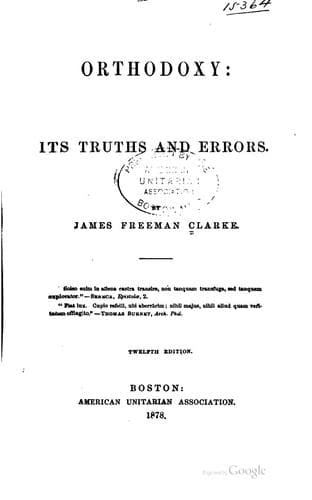
Orthodoxy: Its Truths And ErrorsClarke, James Freeman
Religion
Orthodoxy: Its Truths And Errors
Clarke, James Freeman
Unitarianism
Moreover, the Unitarians are fully justified in saying that the New
Testament nowhere asserts that the primary and immediate influence of the
death of Jesus is upon the divine attributes. In every instance Christ is
said to reconcile us to God, never to reconcile God to us. (See Rom. 5:10,
11; 11:15. 2 Cor. 5:18, 19, 20. Eph. 2:13, 16. Coloss. 1:20, 21. 1 Peter
3:18.) It is we “who were afar off, and have been made nigh, by the blood
of Christ.” It is _we_, “who, when we were enemies, were reconciled to God
by the death of his Son;” not God, who was afar off, who has been brought
nigh to us; not God, who has been reconciled to us. It is “_we_, who have
received the atonement.” Christ has suffered for sins, “to bring _us_ to
God,” not to bring God to us. All this is plain, positive, and
unequivocal.
And yet, notwithstanding that the Old and New Testaments declare the
forgiveness of sin to the penitent, we nevertheless find a difficulty in
believing it. It seems as if God _ought_ not to forgive us our sins on so
simple a condition. And it is on this very feeling that the whole Orthodox
theory of the atonement rests.
The explanation of this is, that man is obliged to understand God by
himself. Since man was made in the image of God, he can know God only by
understanding the moral and spiritual laws of his own soul. Now, in
himself, he finds the constant antagonism of truth and love, justice and
mercy, conscience and desire. From this essential original antagonism of
truth and love spring all the moral conflicts which make cases of
conscience. Whenever we see before us a divided duty, on being analyzed,
it resolves itself into this conflict between truth and love. We
naturally, and almost necessarily, transfer this same conflict to the mind
of God. Whenever we wish to forgive an offender, but feel as if we ought
not to do so, we teach ourselves to regard God as feeling the same
difficulty. Conscience tells us that we are not fit to be forgiven, that
it would be wrong for God to forgive us. Orthodoxy plants itself on this
instinct, and elaborates its various theories, which men accept for a time
as a sufficient explanation of their difficulty, and then reject when
their inconsistencies appear. The deep-lying difficulty is the sense of
our want of holiness, and the instinctive feeling of the eternal mutual
repulsion of good and evil. Since God is good, and we are evil, how can he
forgive us? If forgiveness merely meant the remitting of penalty, it might
be done after sufficient expiation. If forgiveness meant laying aside of
anger, we can well believe that God cannot retain wrath against his
children. But forgiveness means communion, the mutual love of father and
child, the being always in the presence of God. And for this, even after
we have repented, and are endeavoring to do right, we do not feel
ourselves qualified.
Public-domain text, read in full here on John Shaqi.
Reviews
Reviews
No reviews yet
Be the first to share your thoughts on this work.
Elsewhere in the archive
Join the Discussion
Join the discussion
Sign in to leave a comment or review.
Sign InorCreate an account