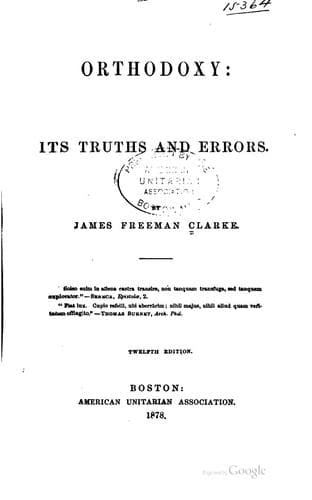
Orthodoxy: Its Truths And ErrorsClarke, James Freeman
Religion
Orthodoxy: Its Truths And Errors
Clarke, James Freeman
Unitarianism
The Old School Presbyterianism, or Princeton Orthodoxy, accepts it in its
entireness. They simply deny the consequences supposed to be drawn from
it. They deny that it makes God the author of sin, or that sinful
dispositions are created by God. They deny that this doctrine interferes
with freedom of will in man. But they are obliged to admit that, according
to their creed, God decrees things which he forbids; for, “inasmuch as
many things occur contrary to his commands, while yet he foreordains all
things, it must be that in these cases he purposes one thing and commands
another.”(22) In other words, God sends his prophets, and apostles, and
Son, to command men to do justly and love mercy, when he has already
determined that they shall commit sin. This school rejects the Arminian
doctrine that God’s decree is founded on his foreknowledge, and asserts
that his foreknowledge is based on his decree.
The Old School in New England do not go quite so far as Princeton. They
say, decidedly, that God foreordains sin only by permitting it. Still,
they reject, as stoutly as their sterner _confrères_, the Arminian view,
and insist that God’s decrees are not based on his foreknowledge.(23)
According to Dr. Duffield, of Detroit, the New School Presbyterians escape
the pinch of this conflict by taking refuge in their ignorance. They are
not “Ultra-Calvinists,” and they are not “Arminians,” and especially they
“do not wish to be wise above what is written.”(24) Dr. D. asserts that
the Old School makes the decree in election to be wholly arbitrary, while
the New School believes that it has a reason, though one wholly unknown.
But the Hopkinsians(25) say that “the sovereignty of God belongs to him as
the Supreme Disposer, and consists in his perfect right and perfect
ability to do us he pleases.” Of course, having made the will of God
wholly arbitrary, they proceed to deny that it is arbitrary, or that
wilfulness in God can possibly be wilful. But all this is using “words of
wind for the Almighty,” and “accepting his person.”
Public-domain text, read in full here on John Shaqi.
Reviews
Reviews
No reviews yet
Be the first to share your thoughts on this work.
Elsewhere in the archive
Join the Discussion
Join the discussion
Sign in to leave a comment or review.
Sign InorCreate an account