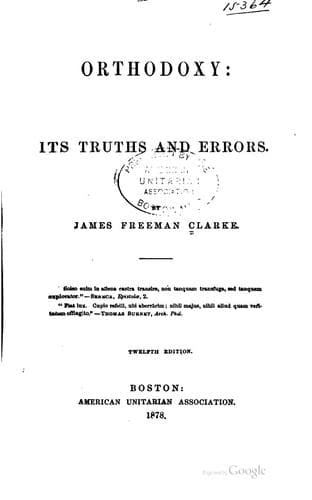
Orthodoxy: Its Truths And ErrorsClarke, James Freeman
Religion
Orthodoxy: Its Truths And Errors
Clarke, James Freeman
Unitarianism
Methodism, on the contrary, denies that God foreordains whatsoever comes
to pass, holding foreordination to be a causative act.(26) It also denies
that man is guilty for inherited sin, or is any way responsible for his
depraved nature. He only becomes responsible when he begins to act freely.
He may suffer for inherited evil, but cannot justly be punished for it.
Thus Methodism avoids the rude injustice of the Calvinistic system. And
yet, as Schleiermacher has shown,(27) if it accepts total depravity, it
must also consistently accept the Calvinistic doctrine of election. For if
man is totally depraved, he cannot take a single step towards his own
salvation. God must, in every case, take the initiative, and begin the
conversion of each man who is converted. Therefore, if we ask why one man
is converted, and another not, the only answer possible is this—that God
chose to convert one, and not the other. Schleiermacher accepts and
defends the doctrine of election, but by connecting it with that of
universal restoration, which reduces it to the statement that God saves
all, but in a certain order, which order is determined by himself, without
regard to any foresight of merit or demerit in man.
§ 2. Scripture Basis for this Doctrine.
The principal passages relied upon for the doctrine of absolute decrees
are found in Rom. 8:30, and 9:8-24. In these passages, Paul is, no doubt,
speaking of an unconditional election. In the first, he declares that the
gift of Christianity to those who received it was no accident. God had
known them long ago as individuals, known them before they were born,
known the character they were to have. He had foreordained them to become
Christians, to be made into the likeness of Christ. He had called them to
be Christians by his providence; he had forgiven them their sins; he had
glorified them, filling them with the glory of the new life of faith and
love. In the other passage, Paul shows the Jews that God selects races and
families, not according to any merit of theirs, but for reasons of his
own, to do his work. Ishmael as well as Isaac was a child of Abraham, but
Isaac was selected. Esau as well as Jacob was a child of Isaac, but Jacob
was selected. It is no merit of the man which causes him to be chosen, no
fault which causes him to be rejected, but that one is made for the work,
and the other not. One is influenced to obey and serve; one is allowed to
resist God’s will; and yet both of them—he who obeys and he who
resists—serve the divine purpose. The Jewish Christians, therefore, may
believe that their nation, in resisting Christ, is blindly serving the
providential designs of God, and making way for the Gentiles to come in;
and then, the Gentiles, in turn, will help _them_ to come in, “and so all
Israel shall be saved.” But in neither of these passages is any reference
to final salvation or damnation. All that is spoken of is the predestined
Public-domain text, read in full here on John Shaqi.
Reviews
Reviews
No reviews yet
Be the first to share your thoughts on this work.
Elsewhere in the archive
Join the Discussion
Join the discussion
Sign in to leave a comment or review.
Sign InorCreate an account