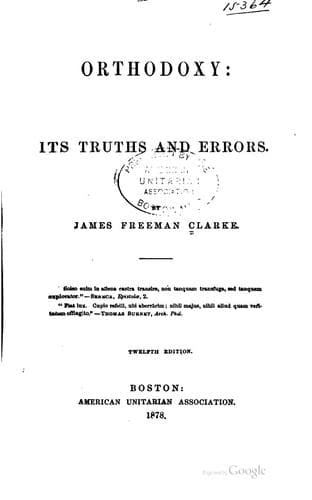
Orthodoxy: Its Truths And ErrorsClarke, James Freeman
Religion
Orthodoxy: Its Truths And Errors
Clarke, James Freeman
Unitarianism
But it is not merely great men, and men of genius, who are thus
providentially chosen and sent. _Every_ man is chosen for something, and
that something not vague and general, but special and distinct.
You go into some country village of New England. You find there some plain
farmer, of no great education, perhaps, but endowed with admirable insight
and sagacity, and of a kind and benevolent nature. He has come to be the
counsellor and adviser of the whole community. He has no title; he is not
even a “squire.” He has no office; he is not even a justice of the peace.
But he fulfils the mission of peace-maker and of sagacious counsellor. He
is judge without a seat on the bench; he is spiritual guide without being
called “reverend;” he is the stay, the centre, the most essential person
in the place. He has had an evident calling from God, not from man, and he
has made it sure by his diligence and fidelity in his work.
And perhaps in the same village is a woman, poor, old, and uneducated. But
she, too, has a calling from God. She is always sent for in the hour of
trial. If any accident happens, she is there. Her sagacity and experience
help her to do what is needed. She has no medical diploma, but she is the
good physician of the place. God gave to her native sagacity, gave to her
benevolence, gave her acute observation and a good memory, and she has
made her election sure by her own fidelity.
Some persons are called to love and teach little children: that is _their_
work. They are happy with children, and children are happy with them. Some
are called to sympathize; their natures overflow with sympathy; they enter
readily into all trials and into the troubles of every soul, and they pour
oil and wine into the wounds of the heart. God called them to be his good
Samaritans, and they hear the call and obey.
“A place for everything, and everything in its place,” says the prudent
housekeeper. “A place for every man, and every man in his place,” says the
divine Housekeeper, who has so many mansions in his house, and whose Son
said he went to prepare a place for us there in the other world—a working
place, probably, and a sphere of labor there as here. But in this world,
too, what a delight it is to see any one in his right place!
There are different ways in which God calls us, and different kinds of
callings. But every calling of God is good and noble. He calls us to work;
he calls us to Christian goodness; he calls us to heavenly joy, to glory,
honor, and immortality. These are the three great callings of
man—Christian work first, Christian goodness next, Christian glory last.
Since God made every one of us, he made every one of us for something; he
has appointed a destiny for each one, and he calls us to it. If we do not
hear the gentle call, the whisper of his grace, he calls us by trial, by
disaster, by disappointment. He chastens us for our profit. He prunes our
too luxuriant branches that we may bring forth more fruit.
Public-domain text, read in full here on John Shaqi.
Reviews
Reviews
No reviews yet
Be the first to share your thoughts on this work.
Elsewhere in the archive
Join the Discussion
Join the discussion
Sign in to leave a comment or review.
Sign InorCreate an account