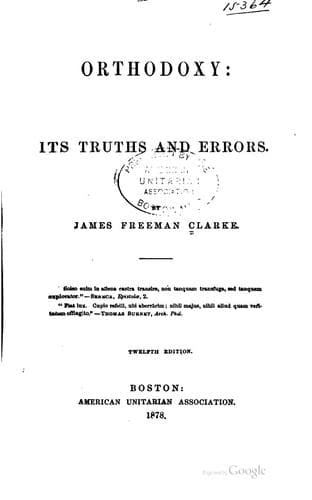
Orthodoxy: Its Truths And ErrorsClarke, James Freeman
Religion
Orthodoxy: Its Truths And Errors
Clarke, James Freeman
Unitarianism
So this doctrine of election, in its other form, as usually taught by
Orthodoxy, so harsh and terrible,—“_horrible decretum_,”—so dishonorable
to God, so destructive to morality, so palsying to effort, grows lovely
and encouraging when looked at aright.
As one grows old, and looks back over his past life, he sees the working
of this divine decree—working where he concurred with it, working where he
resisted it. He sees more and more clearly what his election was, and how
he has fulfilled it, how far failed. He sees himself as a youth, fiery and
ardent, striving for one thing, educated by God for another. He sees how
he was partly led and partly driven into his true work; how he has been
made an instrument by God for good he never dreamed of to God’s other
children. He says, “It is no doing of mine. It is the Lord’s doing. He
chose me for it before the foundation of the world. I builded better than
I knew. I have failed in a thousand plans of my own, but I have ignorantly
fulfilled God’s plans. I am like Saul, the son of Kish, who went out to
seek his father’s asses, and found a kingdom. I am like Schiller’s
explorer, who went to sea with a thousand vessels, and came to shore saved
in a single boat, yet having in that boat the best result of the whole
voyage.”
CHAPTER XII. IMMORTALITY AND THE RESURRECTION.
§ 1. Orthodox Doctrine.
The Orthodox doctrine of the future life is thus stated in the Assembly’s
Catechism, chapter 32:—
“I. The bodies of men, after death, return to dust, and see corruption;
but their souls (which neither die nor sleep) having an immortal
subsistence, immediately return to God who gave them. The souls of the
righteous, being then made perfect in holiness, are received into the
highest heavens, where they behold the face of God, in light and glory,
waiting for the full redemption of their bodies. And the souls of the
wicked are cast into hell, where they remain in torments and utter
darkness, reserved to the judgment of the great day. Besides these two
places for souls separated from their bodies, the Scripture acknowledged
none.
“II. At the last day, such as are found alive shall not die, but be
changed; and all the dead shall be raised up with the selfsame bodies, and
none other, although with different qualities, which shall be united again
with their souls forever.
“III. The bodies of the unjust shall, by the power of Christ, be raised to
dishonor; the bodies of the just by his Spirit unto honor, and be made
conformable to his own glorious body.”
Public-domain text, read in full here on John Shaqi.
Reviews
Reviews
No reviews yet
Be the first to share your thoughts on this work.
Elsewhere in the archive
Join the Discussion
Join the discussion
Sign in to leave a comment or review.
Sign InorCreate an account