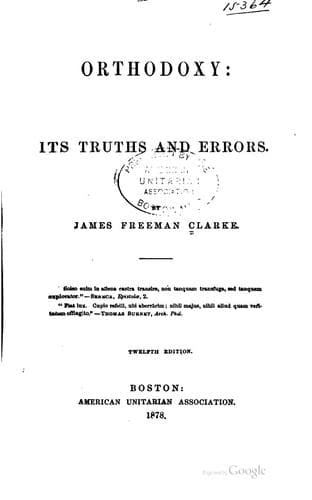
Orthodoxy: Its Truths And ErrorsClarke, James Freeman
Religion
Orthodoxy: Its Truths And Errors
Clarke, James Freeman
Unitarianism
The fear of death is natural to all men, but it is easily removed. The
smallest and lowest power of the resurrection is shown in removing it.
The fear of death is natural. It consists in this—that we are, in a great
part of our nature, immersed in the finite and perishing. “When we look at
the things which are seen,” which “are temporal,” we have an inward
feeling of instability—nothing substantial. Therefore it is said, “In Adam
all die,” for the Adam, the first man in all of us, is the animal soul.
“The first man is of the earth, earthy.” The law of our life is, that it
comes from our love. When we love the finite, our life is finite. But
besides the finite element in man, the animal soul, or Adam, is the
spiritual element, or Christ, the life flowing from things unseen, but
eternal.
Christ has abolished death. There is now to the Christian no such thing as
death, in the common sense of the term. The only death is the sense of
death, the fear of death, which insnares and enslaves. Jesus delivers us
from this by inspiring us with faith. We rise with him when we look with
him at the things unseen. Faith in eternal things brings into the soul a
sense of eternity. Death is only a sleep: outward death is the sleep of
the bodily life; inward death is the sleep of the higher life. We awake
and rise from the dead when Christ gives us life; and when he, who is our
life, shall appear, we shall also appear with him.
The philosopher Lessing says, “Thus was Christ the first _practical_
teacher of the immortality of the soul. For it is one thing to conjecture,
to wish, to hope for, to believe in immortality as a philosophical
speculation—another thing to arrange all our plans and purposes, all our
inward and our outward life, in accordance to it.”
Jesus also destroys the Jewish idea of death, as a passage from a world
where the good suffer and the bad triumph, to a world where this state of
things is reversed. The kingdom of heaven, with him, begins here, in this
world. Judgment is here as well as hereafter. The Jew lived, and all
Judaizing Christians live, under a fearful looking for of judgment after
death. The Christian sees that judgment is always taking place; that
Christ is always judging the world; that God’s moral laws and their
retributions are not kept in a state of suspense till we die—that they
operate now daily. The Christian knows that heaven and hell are both here,
and he expects to find them hereafter, because he finds them here. He
believes in law, but not in law only. He believes in something higher than
law, namely, love—the love of a present, helpful Father, of a friend near
at hand, of an inspiration from on high, of a God who forgives all sins
when they are repented of, and saves all who trust in him. He is not under
law, but under grace.
Public-domain text, read in full here on John Shaqi.
Reviews
Reviews
No reviews yet
Be the first to share your thoughts on this work.
Elsewhere in the archive
Join the Discussion
Join the discussion
Sign in to leave a comment or review.
Sign InorCreate an account