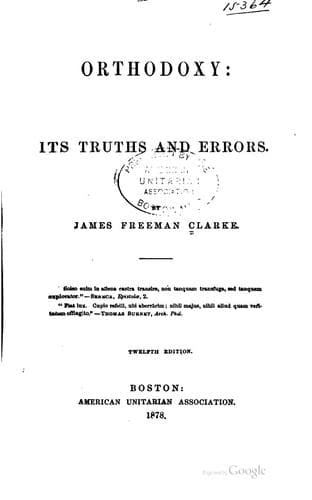
Orthodoxy: Its Truths And ErrorsClarke, James Freeman
Religion
Orthodoxy: Its Truths And Errors
Clarke, James Freeman
Unitarianism
JUDAISM, in its view of hereafter, is much more positive. It began with no
idea of a hereafter. Nothing is taught concerning a future life by Moses,
and little is to be found concerning it even in the prophets. The
explanation is simple. Men hard at work in the present do not think much
of the future; and the work of the Jews was to be servants of Jehovah and
doers of his law here. However, all men must think a little of the region
beyond death. When the Jews thought of it, they projected their LAW upon
its blank spaces. It was a place where Jehovah would vindicate his
law—where the just should be happy, the unjust miserable. The perplexity
which tormented Job, David, and Elijah—namely, that bad men should succeed
in this world and good men fail—was to find its solution there. Judgment
was the Jewish idea of hereafter—a judgment to come. “I have a hope toward
God, as they themselves also allow,” said Paul, speaking of the Pharisees,
“that there shall be a resurrection of the dead, of the just, and also of
the unjust.”
The CHRISTIAN view of death is, that it is abolished—it has ceased to be
anything. The New Testament distinctly says, “who has _abolished_ death,
and brought life and immortality to light.”(32) Death, to a Christian, is
but a point on the line of advancing being; a door through which we pass;
a momentary sleep between two days. In the same sense the Saviour says,
“He that liveth and believeth on me shall never die.”
So also he spoke of Lazarus as being only asleep, and said of the daughter
of Jairus, “She is not dead, but sleepeth.”
Certainly Jesus could not have spoken of death in this way if he regarded
it as the awful and solemn thing which most believers consider it. If it
is the moment that decides our eternal destiny, which shuts the gate of
probation, which terminates for the sinner all opportunity of repentance
and conversion, for the saint all danger of relapse and fall,—then death
is surely something, and something of the most immense importance.
But Christ has really destroyed death both in the Pagan and in the Jewish
feeling concerning it. He destroys the Pagan idea of death as a plunge
downward from something into nothing, a descent into non-entity or
half-entity, a diminution of our being, a passage from the substantial to
the shadowy and unreal.
For, according to Christianity, we do not descend in death; we ascend into
more of reality, into higher life. Death is a passage onward and upward.
The proof of this we find in the Christian doctrine of the RESURRECTION.
The meaning of the resurrection of Christ is not, as has been often
supposed, that after death he came to life _again_, but that at death he
rose; that his death was rising up, ascent. This we shall show in a future
section of this chapter.
One power of Christ’s resurrection was to abolish the _fear of death_. It
brought life and immortality to _light_. It showed men their immortality.
Public-domain text, read in full here on John Shaqi.
Reviews
Reviews
No reviews yet
Be the first to share your thoughts on this work.
Elsewhere in the archive
Join the Discussion
Join the discussion
Sign in to leave a comment or review.
Sign InorCreate an account