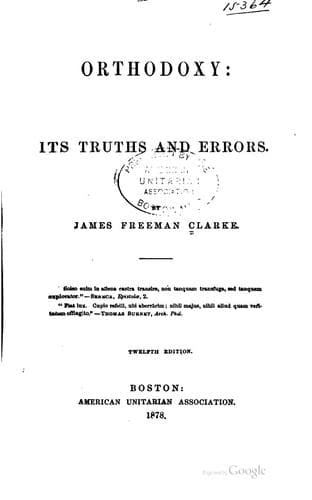
Orthodoxy: Its Truths And ErrorsClarke, James Freeman
Religion
Orthodoxy: Its Truths And Errors
Clarke, James Freeman
Unitarianism
So it has been in regard to this subject. We Paganize and Judaize in our
view of death. We reëstablish again what Christ has abolished. We make
death something where Christ made it nothing. It is made the great duty of
life to “prepare for death.” No such duty is pointed out in the New
Testament. Our duty is to prepare every day _to live_; then, when we die,
we shall be taken care of by God. We can safely leave the other world and
its interests to Him who has shown himself so capable of taking care of us
here.
The gloom of death has been heightened by artificial means. Mourning
dresses, solemn faces, funeral addresses, the grave,—all have had an
unnatural depth of awe added to the natural sense of bereavement. The
Orthodox Church has deliberately and systematically Paganized and Judaized
in what it has said and done about death. Its object has been always to
make use of the great lever of fear of a hereafter in order to enforce
Christian belief and action. Hence Death has been made the king of
terrors, the close of probation, the beginning of judgment, the awful
entrance to the final decision of an endless doom. All this is wholly
unchristian, unknown to apostolic times, a relapse towards Paganism. It is
utterly opposed to the great declaration that “CHRIST HAS ABOLISHED DEATH,
AND BROUGHT LIFE AND IMMORTALITY TO LIGHT THROUGH THE GOSPEL.”
What is called faith in immortality, therefore, is of two kinds: it is an
instinct, and it is a belief. In the New Testament these are plainly
distinguished. In the passage just quoted, it is said that Jesus “brought
life AND immortality to light.” Jesus himself says, “I am the resurrection
AND the life.” “He that believeth in me hath eternal life abiding in him,
AND I will raise him up at the last day.”
Life is a matter of consciousness. It is a present possession, something
abiding in us now.
Immortality, or the resurrection, is an object of intellectual belief. It
is something future. We _feel_ life; we believe in the resurrection.
We will pass on, in the next sections, to consider each of these.
§ 4. Eternal Life, as taught in the New Testament, not endless Future
Existence, but present Spiritual Life.
It is only necessary carefully to examine the passages in the New
Testament where the phrase “eternal life” (ζωή αἰώνιος) occurs, to see
that it does not refer to the duration, but to the quality, of existence.
_Temporal life_ is that life of the soul which through the body is subject
to the vicissitudes of time. _Eternal_ (or everlasting) _life_ is that
life of the spirit which is independent of change, and is apart from
duration. God’s being was regarded by the Semitic races as outside of time
and space, as a perpetual Now, without before or after. (“I am the _I
Am_.” Exod. 3:14.) Man, made in the image of God, becomes a “partaker of
the divine nature” (2 Peter 2:4) by the gift of eternal life.
That “eternal life” is not an endless temporal existence appears,—
Public-domain text, read in full here on John Shaqi.
Reviews
Reviews
No reviews yet
Be the first to share your thoughts on this work.
Elsewhere in the archive
Join the Discussion
Join the discussion
Sign in to leave a comment or review.
Sign InorCreate an account