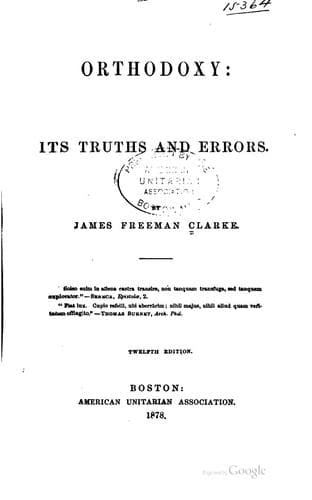
Orthodoxy: Its Truths And ErrorsClarke, James Freeman
Religion
Orthodoxy: Its Truths And Errors
Clarke, James Freeman
Unitarianism
(_a._) From the passages in which it is spoken of as something to be
obtained by one’s own efforts, as (Matt. 19:16) when the young man asks of
Jesus what good thing he shall do that he may have eternal life, and Jesus
replies that he must keep the commandments, give his possessions to the
poor, and come and follow him. Certainly that was not the method to obtain
an endless existence, but it was the true preparation for receiving
spiritual good. So Jesus tells Peter (Mark 10:30) that those who make
sacrifices for the sake of truth shall receive temporal rewards “in this
time;” and “in the coming age eternal life” (“ἐν τῷ αἰῶνι τῷ ἐρχομένῳ ζωὴν
αἰώνιον”). The coming age is the age of the Messiah, when the gift of the
Holy Ghost should be bestowed.
(_b._) Passages in which eternal life is spoken of as a present
possession, not a future expectation. (John 3:36.) “He that believeth on
the Son _hath_ (ἔχει) eternal life.” So John 6:47, 54, &c.
(_c._) Passages in which eternal life is defined expressly as a state of
the soul. (John 17:3.) “This is life eternal, that they may know thee the
only true God, and Jesus Christ whom thou hast sent,” &c.
So (Gal. 6:8) it is represented as the natural result of “sowing to the
Spirit;” (Rom. 2:7) of “patient continuance in well-doing;” as “the gift
of God” (Rom. 6:23); as something which we “lay hold of” (1 Tim. 6:12,
19).
This view of “eternal life” is taken by all the best critics. Professor
Hovey thus sums up their testimony:—(33)
“On a certain occasion, Christ pronounced it necessary for the Son
of Man to be lifted up, ‘that whosoever believeth in him should
not perish, but _have eternal life_’ (John 3:15)—ἔχῃ ζωήν αἰώνιον.
Ζωὴν αἰώνιον, says Meyer, who is, perhaps, the best commentator on
the New Testament, of modern times, ‘signifies the eternal
Messianic life, which, however, the believer already
possesses—ἔχῃ—in this αἰὼν, that is, in the temporal development
of that moral and blessed life which is independent of death, and
which will culminate in perfection and glory at the coming of
Christ.’ And Lücke, whose commentary on the Gospel of John is one
of the most thorough and attractive in the German language, says
that the ζωὴ αἰώνιος, which is the exact opposite of ἀπώλεια
(destruction), or θάνατος (death), is the sum of Messianic
blessedness. It is plain, we think, that the life here spoken of
as the present possession of every believer in Christ is more than
endless existence; it is life in the fullest and highest sense of
the word, the free, holy, and blessed action of the whole man,
that is to say, the proper, normal living of a rational and moral
being. The germ, the principle of this life, exists in the heart
of every believer; it is a present possession. ‘Whosoever,’ says
Christ, ‘drinketh of the water that I shall give him shall never
thirst; but the water that I shall give him shall be in him a
Public-domain text, read in full here on John Shaqi.
Reviews
Reviews
No reviews yet
Be the first to share your thoughts on this work.
Elsewhere in the archive
Join the Discussion
Join the discussion
Sign in to leave a comment or review.
Sign InorCreate an account