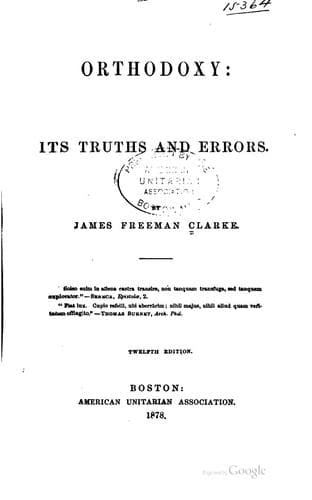
Orthodoxy: Its Truths And ErrorsClarke, James Freeman
Religion
Orthodoxy: Its Truths And Errors
Clarke, James Freeman
Unitarianism
“Again: we find our Saviour saying, ‘He that believeth on me hath
everlasting life;’ ‘Except ye eat the flesh of the Son of man, and
drink his blood, ye have no life in you;’ and, ‘The words that I
speak unto you are spirit, and are life.’ (John 6:47, 53, 63.) By
these verses we are taught once more, that the Greek terms which
denote life and death, living and dying, were applied by Christ to
opposite moral states of the soul. For, observe, (1.) he more than
intimates that his words, his doctrines, are the source of present
life to those who receive them, and that, by eating his flesh and
drinking his blood, he signifies a reception of his words, and so
of himself as the Lamb of God. And, (2.) he declares that one who
believes _has_ eternal life; that one who eats of the true bread
shall not die, but shall live forever; and that one who does not
eat the flesh and drink the blood of the Son of man _hath not
life_ in himself.
“Is it not plain that the words _life_ and _death_, as well as the
words _bread_, _flesh_, and _blood_, _eating_ and _drinking_, are
here used in a spiritual sense? Is it not plain that Jesus here
speaks of something in the believer’s soul which is nourished by
Christian truth, and which is at the same time called _life_? But
it is the function of truth to quicken thought and feeling, to
determine the modes of conscious life, the character or moral
condition of the human soul; and hence the rejection of it may
involve the utter want of certain spiritual _qualities_ and
blessed _emotions_, but not the want of personal existence. In
still another place we read, ‘Jesus said unto her, I am the
resurrection and the life: he that believeth in me, though he were
dead, yet shall he live; and whosoever liveth and believeth in me
shall never die.’ (John 11:25, 26.) Christ here affirms that every
believer is exempted from death. And it matters not for our
present purpose whether the word ζῶν, translated in our version
‘liveth,’ refers in this passage to physical or to moral life. If
it refers to physical life, then our Saviour pronounces the
Christian to be already, in time, delivered from the power of
death, and in possession of a true and immortal life. But if it
refers to moral life, Christ declares that whoever possesses this
life, whether in the body or out of the body, is delivered from
the power of death; that is, his union with God and delight in
him, which alone constitute the normal living of the soul, shall
never be interrupted: οὐ μὴ ἀποθάνῃ εἰς τὸν αἰώνα—_he shall never
die_....
Public-domain text, read in full here on John Shaqi.
Reviews
Reviews
No reviews yet
Be the first to share your thoughts on this work.
Elsewhere in the archive
Join the Discussion
Join the discussion
Sign in to leave a comment or review.
Sign InorCreate an account