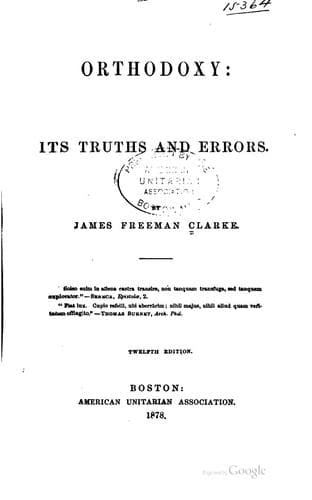
Orthodoxy: Its Truths And ErrorsClarke, James Freeman
Religion
Orthodoxy: Its Truths And Errors
Clarke, James Freeman
Unitarianism
fountain—πηγὴ—of water, springing up into everlasting life.’ (John
4:14.) In another place our Saviour utters these words: ‘He that
heareth my word, and believeth on him that sent me, _hath eternal
life_, and shall not come into condemnation, _but has passed from
death into life_’ (John 5:24)—μεταβέβηκεν ἐκ τοῦ θανάτου εἰς τὴν
ζωήν. Here, again, the believer is said to _have_ eternal life,
even now; for he has passed from death into life. _Ingens saltus_,
remarks Bengel, with his customary brevity and graphic power. We
translate a part of Lücke’s ample and instructive note on this
important verse.
“ ‘The words, “Has passed from death into life” determine that
ἔχει (_hath_) must be taken as a strict present. For the verb
μεταβέβηκεν (_has passed_) affirms that the transition from death
into life took place with the hearing and believing. Only if an
impossible thought were thus expressed, could we consent, as in a
case of extreme necessity, to understand the present ἔχει and the
present perfect μεταβέβηκεν as futures. And then we should be
compelled to say that John had expressed himself very strangely.
But if a higher kind of life, a resurrection process prior to
bodily death, is represented by “hath,” and “hath passed,” then
ζωὴ and ζωὴ αἰώνιος are not to be understood of a life commencing
after bodily death, but of the true and eternal Messianic life or
salvation, beginning even here. This life does not, to be sure,
exclude natural death, but neither does it first begin after this
death. (Cf. 5:40.) Even so θάνατος cannot be understood of bodily,
but only of spiritual death, of lying in the darkness of the
world. This interpretation would be justified here, even if
θάνατος elsewhere in the New Testament denoted uniformly nothing
but bodily death. But the metaphorical idea of death stands out
clearly in 1 John 3:14; 5:16, 17; John 8:51, 52; 2 Cor. 2:16;
7:10. Similar, also, is the use of the words θανατοῦν (Rom. 7:4;
8:13), and νεκρός, νεκροῦν, ἀποθνήσκειν (Matt. 8:22; Eph. 5:14;
Heb. 6:1; Col. 3:5; Gal. 2:19).’
“With the passage now examined may be compared a statement of the
apostle John to the same effect, namely: ‘We know that we have
passed from death into life, because we love the brethren; he that
loveth not abideth in death.’ (1 John 3:14.) This language,
explained with a due regard to the preceding context, speaks,
evidently, of spiritual death and life, of a passing from one
moral condition into another and opposite one. To say that this
new moral condition and blessed state is to endure and improve
forever, may doubtless be to utter an important truth, but one
which does not conflict in the slightest degree with its present
existence. It begins in this life; it continues forever and ever.
Public-domain text, read in full here on John Shaqi.
Reviews
Reviews
No reviews yet
Be the first to share your thoughts on this work.
Elsewhere in the archive
Join the Discussion
Join the discussion
Sign in to leave a comment or review.
Sign InorCreate an account