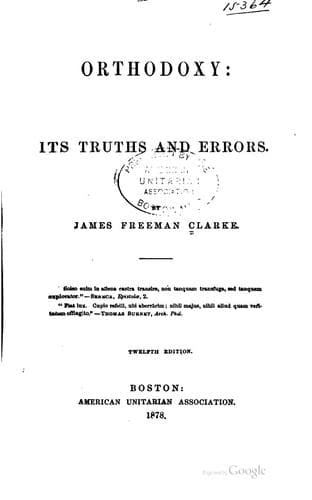
Orthodoxy: Its Truths And ErrorsClarke, James Freeman
Religion
Orthodoxy: Its Truths And Errors
Clarke, James Freeman
Unitarianism
The natural instinct of immortality is the spirit, or sense of the
infinite and eternal. But it needs to be reënforced by the influence of
Christian conviction, hope, and experience, in order completely to conquer
the sense of death. It is not by logical arguments in proof of a future
existence that immortality becomes clear to us, but by living an immortal
life. Dr. Channing says truly, “Immortality must begin here.” And so Hase
(Dogmatic, § 92) says, “Any proof which should demonstrate, with
mathematical certainty, to the understanding, or to the senses, the
blessings or terrors of our future immortality, would destroy morality in
its very roots. The belief in immortality is therefore at first only a
wish, and a belief on the authority of others; but the more that any one
assures to himself his spiritual life by his own free efforts and a pure
love for goodness, the more certain also does eternity become, not merely
as something future, but as something already begun.”(36)
Whenever Jesus is said to give eternal life, or to be the life of the
world; whenever the apostles declare Christ to be their life, or say that
as in Adam all die, so in Christ shall all be made alive; when Paul says,
“The law of the Spirit of life in Christ Jesus has made me free from the
law of sin and death;” “to be spiritually minded is life and peace;” “the
life of Jesus is manifested in our dying (mortal) flesh;” when John says,
“He that hath the Son hath life;” when in Revelation we read of the book
of life, and water of life, and tree of life,—the meaning is always the
same. It refers to the spiritual vitality added to the soul by the
influence of Jesus, who communicates God’s love, and so enables us to LOVE
God, instead of merely fearing him or obeying him. Love casts out all
fear, the fear of death included. He who looks at the things unseen and
eternal, partakes of their eternal nature, and though his outward human
nature perishes, his inward spiritual nature is renewed day by day.
§ 5. Resurrection, and its real Meaning, as a Rising up, and not a Rising
again.
One part of the Christian doctrine of immortality is conveyed in the term
“eternal life;” the other part in the other term, usually associated with
it—“the resurrection.” The common Orthodox doctrine of the resurrection,
is that the dead shall rise with the same bodies as those laid in earth;
and this identity is usually made to consist in identity of matter, though
Paul expressly says, “Thou sowest _not_ that body that shall be.” On the
other hand, many liberal thinkers of the Spiritual School deny any
resurrection, and think the whole doctrine of the resurrection a Jewish
error, believing in a purely spiritual existence hereafter. Others, like
Swedenborg, teach that the soul hereafter dwells in a body, though of a
more refined and sublimated character; and in this we think they approach
more nearly the teaching of the New Testament.
Public-domain text, read in full here on John Shaqi.
Reviews
Reviews
No reviews yet
Be the first to share your thoughts on this work.
Elsewhere in the archive
Join the Discussion
Join the discussion
Sign in to leave a comment or review.
Sign InorCreate an account