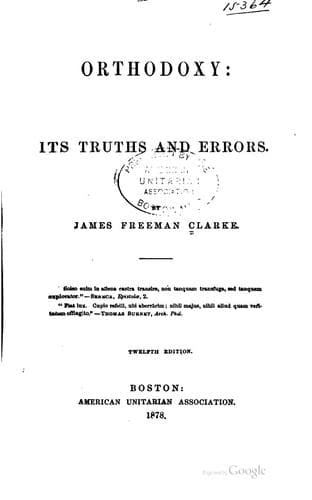
Orthodoxy: Its Truths And ErrorsClarke, James Freeman
Religion
Orthodoxy: Its Truths And Errors
Clarke, James Freeman
Unitarianism
It is a remarkable fact that the Greek words indicating the rising of men
should have been translated, in our English Bible, by terms signifying
something wholly different, and conveying another sense than that in the
original. It is equally extraordinary that this change of meaning should
seldom or never be alluded to by theological writers.
These words, translated “resurrection,” “rise again,” and the like, all
have, in the Greek, the sense of rising UP, not of rising AGAIN. They
signify not return, but ascent; not coming back to this life, but going
forward to a higher. The difference in meaning is apparent and very
important. It is one thing to say, that at death we go down into Hades, or
into dissolution, and at the resurrection we come back to conscious
existence, or to the same life we had before, and quite a different thing
to say that what we call death is _nothing_; but that we rise _up_, and go
forward when we seem to die. This last is the doctrine of the New
Testament, though the former is the one usually believed to be taught in
it.
The immense stress laid, in the New Testament, on the resurrection of
Jesus is by no means explained by supposing that after his death he came
to life again, and so proved that there is a life after death. What he
showed his disciples was, that death was not going down, but going up; not
descent into the grave, or Hades, but ascent to a higher world. This is
the evident sense of such passages as these. We have not room to go over
all the passages which should be noticed in a critical examination, but
select a few of the most prominent.
1. Ἀνάστασις, commonly translated “resurrection,” or “rising again,” but
which literally means “rising up.” (So Bretschneider, “Lexicon Man. in
lib. Nov. Test.” defines it as “resurrectio, _rectius_ surrectio.”)(37)
This word occurs forty-two times in the New Testament. In _none_ of them
(unless there be a single exception, which we shall presently consider)
does it necessarily mean _a rising again_, or coming back to the same
level of life as before. In a large number of instances the word _can
only_ mean a _rising up_, or ascent to a higher state. Of these cases we
will cite a few examples.
Public-domain text, read in full here on John Shaqi.
Reviews
Reviews
No reviews yet
Be the first to share your thoughts on this work.
Elsewhere in the archive
Join the Discussion
Join the discussion
Sign in to leave a comment or review.
Sign InorCreate an account