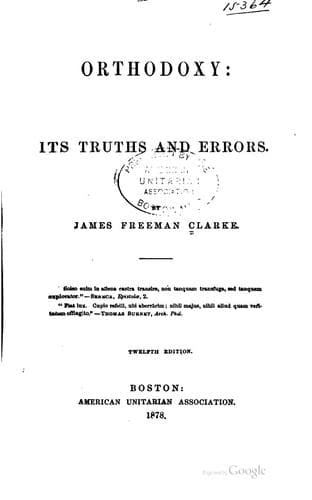
Orthodoxy: Its Truths And ErrorsClarke, James Freeman
Religion
Orthodoxy: Its Truths And Errors
Clarke, James Freeman
Unitarianism
Ten of the passages in which the word ἀνάστασις occurs, are in the account
by the Synoptics of the discussion between Jesus and the Sadducees
concerning the case of the woman married to seven brothers. After stating
the case, they say, “Therefore, _in the resurrection_, whose wife of them
is she?” It is plain that the word “resurrection” here is equivalent to
“the future state,” and cannot be limited to a return to life. This
becomes more apparent in the answer of Jesus, as given, somewhat varied,
by the three Synoptics: “In the resurrection they neither marry nor are
given in marriage, but are as the angels of God in heaven.” (Matt. 22:30.)
Mark, instead of “the resurrection,” has the corresponding verb, “when
they shall rise from the dead.” This certainly means, not rising again,
but rising up, ascending to a higher state. And Luke adds another element,
showing that the “resurrection” is a state to which all may not attain,
but which is dependent on character; evidently therefore a higher state.
“They which shall be accounted worthy to obtain that world (τοῦ αιῶνος
ἐχείνου), and the resurrection from the dead, neither marry nor are given
in marriage; neither can they die any more, for they are equal unto the
angels” (or rather “are like the angels”) “and are children of God, being
_children of the resurrection_.” (Luke 20:35, 36.) This last phrase,
“children of the resurrection,” is very significant, and intends a
character corresponding to this higher state. There seems, indeed, to be a
contradiction between this passage, which makes the resurrection
conditional, and those which declare it universal. (See John 5:29, and 1
Cor. ch. 15.) But perhaps the reconciliation can be found in the apostolic
statement (1 Cor. 15:23) “every one in his order.” All shall ascend into
the higher state, called “the resurrection,” but only as they become
prepared for it. All are not now prepared to hear the voice of the Son of
man (or of divine truth), which shall causes them to rise to the
resurrection of life and of judgment; but, in due season, all shall come
forth from their graves, and hear it.
Another passage in which this word occurs is in Luke 2:34, where Simon
says, “This child is set for the fall and _rising again_ (ἀνάστασιν) of
many in Israel.” A moral fall and rising are here evident; and only if the
reduplication be dropped, and we read “for the fall and the rising up,” do
we get the true idea. It is not meant that Jesus comes to degrade us
morally, and then lift us up again morally. Rather it means that he comes
to test the state of the hearts of men: some cannot bear the test, and
fall before it; others, better prepared, rise higher. Here, also,
ἀνάστασις means rising up, and not rising again.
Public-domain text, read in full here on John Shaqi.
Reviews
Reviews
No reviews yet
Be the first to share your thoughts on this work.
Elsewhere in the archive
Join the Discussion
Join the discussion
Sign in to leave a comment or review.
Sign InorCreate an account