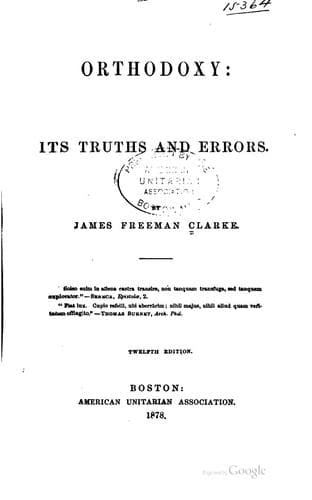
Orthodoxy: Its Truths And ErrorsClarke, James Freeman
Religion
Orthodoxy: Its Truths And Errors
Clarke, James Freeman
Unitarianism
Now, Martha believed, as most of us believe, in a _future_ resurrection.
She believed that, after lying a long time in the grave, one would come
out of it at last, on a great day of judgment, and somehow the soul and
body be reunited. She believed this, for it was the general belief of the
Jews in her day. It is the general belief of Christians now. The majority
of Christians have not got very far beyond that. They talk of the
resurrection, as though it were merely the return of the soul into the old
body; and when you comfort them over their dead by saying, “Your dead will
rise,” reply, “I know it—at the resurrection, at the last day.” But Jesus
tells Martha, and all the Martha Christians of the present time, that he
_is_ the resurrection and the life. Your brother is not to sleep in the
dust till the last day, and then rise. He does not die at all. He rises
with Christ here, and in whatever other world. His nature is to go _up_,
not down, when he is Christianized. Now or then, to-day or at the last
day, if he has the living faith of a son of God, he will be raised by that
Christ within him, who is his life.
This, it seems to us, is the only adequate explanation of this passage,
and shows conclusively that resurrection must mean, in this place, a
rising up to a higher existence, and not a mere return to this life.
It appears, from 1 Cor. ch. 15, that there were some in the Christian
church who said there was no resurrection of the dead (ἀνάστασις νεκρῶν,)
or that it was past already. (2 Tim. 2:18.) These Christians did not deny
the doctrine of immortality, or a future life. It is difficult to imagine
the motive which could induce any one, in those days, to join the
Christian church, if he denied a future life. Probably, therefore, they
assumed that the only real resurrection takes place in the soul when we
rise with Christ. They said, “If we are to rise into a higher life after
this, _how_ shall we rise, and with what bodies?” (1 Cor. 15:35.) They
professed to believe in a simple immortality of the soul, but not an
ascent of the personal being, soul and body together, to the presence of
God. They did not question a future life, but a higher life to which soul
and body should go up together.
Public-domain text, read in full here on John Shaqi.
Reviews
Reviews
No reviews yet
Be the first to share your thoughts on this work.
Elsewhere in the archive
Join the Discussion
Join the discussion
Sign in to leave a comment or review.
Sign InorCreate an account