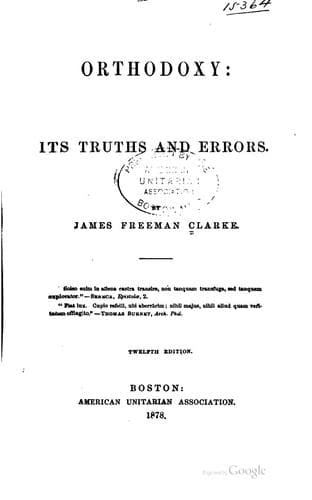
Orthodoxy: Its Truths And ErrorsClarke, James Freeman
Religion
Orthodoxy: Its Truths And Errors
Clarke, James Freeman
Unitarianism
Many persons, however, take an opposite view, and have no belief in any
future bodily existence. They speak much more frequently of the
_immortality of the soul_. But the resurrection of the body is
unquestionably a doctrine of the New Testament, while the immortality of
the soul is not. The New Testament knows nothing of a purely spiritual
existence hereafter, nothing of an abstract disembodied immortality. The
reaction from materialism to idealism has caused us now to undervalue
bodily existence. So it did among the Corinthians to whom Paul wrote, “How
say some among you that there is no resurrection of the dead?” These
Corinthians were not Sadducees, nor Epicureans. There is no evidence that
these sects had any influence on the Christian Church. They did not deny a
_future existence_, but they denied a rising up and a _future bodily
existence_. They believed, like us, in an immortality of the soul, denying
the possibility (probably on philosophical grounds) of the resurrection of
the body. So Paul proceeds, in the fifteenth chapter of Corinthians, first
to prove the fact, and then to explain the nature of a bodily
resurrection.
Let us consider, first, what is meant by a resurrection of the body.
This word _resurrection_ tends to mislead us by suggesting the rising from
the grave of the material body there deposited; and accordingly we have
the theory which makes the future body the mere revival of the same
particles of matter composing the present body. But the Greek word, as we
have fully shown, means not merely rising out of the grave, but rising to
a higher state of existence. The _anastasis_ of the body is its elevation
and spiritualizalion. By the resurrection of the body, we mean that in the
future life of man, he shall not exist in the same material and fleshly
envelope as now, nor yet as a purely disembodied spirit. The true doctrine
avoids both extremes—the extreme of pure idealism on the one hand, and of
pure materialism on the other. It asserts three things: first, that we
have a real body hereafter; second, that this will be identical with our
_true_ body now; third, that it will be this true body in a higher state
of development than at present, a spiritual instead of a natural body.
First, it will be a real body. A real body is an organization with which
the soul is connected, and by means of which it comes into connection with
the material universe, and under the laws of space and time. This
organization may be more or less refined and subtle; it may not come under
the cognizance of our present senses; but if it is an organization by
means of which we may commune with the physical universe, it is
essentially a _body_.
Public-domain text, read in full here on John Shaqi.
Reviews
Reviews
No reviews yet
Be the first to share your thoughts on this work.
Elsewhere in the archive
Join the Discussion
Join the discussion
Sign in to leave a comment or review.
Sign InorCreate an account