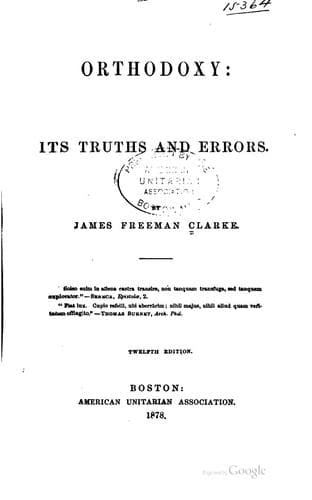
Orthodoxy: Its Truths And ErrorsClarke, James Freeman
Religion
Orthodoxy: Its Truths And Errors
Clarke, James Freeman
Unitarianism
This Christian faith in “resurrection” as ascent to a higher condition of
being at death is practically borne witness to by such common expressions
concerning departed friends as these: “He has gone to a better world;” “He
is in a higher world than this;” “We ought not to grieve for him—he is
better off than he was.” The practical sense of Christendom has taken this
faith from the Gospels, though the Creeds do not authorize it. The Creeds
teach that the souls of the good either sleep till a future resurrection,
or are absorbed into God until then, while the souls of the impenitent
descend to a lower sphere. Christ teaches that at death _all_ rise to a
higher state—of life and love to the loving, or judgment by the sight of
truth to the selfish; but _higher_ to all. Paul declares that “as in Adam
ALL die, even so in Christ shall ALL be made alive,” making the rise
equivalent in extent to the fall.
The great change in the faith of the apostles, in consequence of the
resurrection or ascent of Christ, was this: They before believed that at
death all went to Hades, to the gloomy underworld of shadows, there to
remain till the final resurrection. But the belief that Christ, instead of
going down, had gone up, and had assured them that all who had faith in
him had the principle of ascent in their souls, and were already
spiritually risen,—this took the victory from Hades and the sting from
death.
To Christians, at least, Hades is no more anything; all who have a living
faith rise with Christ; and sooner or later, each in his order, _all_
shall rise. This was the “power of the resurrection” of Jesus to destroy
the fear of death, to enable them “to attain” _now_ “to the resurrection
of the dead” (Phil. 3:10), teaching that “if the Spirit of Him who raised
up Jesus from the dead dwell in you, he that raised up Jesus from the dead
shall also quicken your mortal bodies by his Spirit that dwells in you.”
“For it is Christ that died, _yea, rather, that is risen_, who is even at
the right hand of God, who also maketh intercession for us.” It was,
therefore, the duty of all Christians, since they were risen in Christ,
“to seek the things which are above.”
§ 6. Resurrection of the Body, as taught in the New Testament, not a
Rising again of the same Body, but the Ascent into a higher Body.
It is remarkable that those who profess to believe in the literal
inspiration of the New Testament should nevertheless very generally teach
that the future body is _materially_ the same as this. We often hear
labored arguments to show how the identical chemical particles which
compose the body at death may be re-collected from all quarters at the
resurrection. Yet the only place where any account is given of the future
body, declares explicitly that it is different from the present, just as
the stalk which comes out of the ground differs from the seed planted. “We
sow _not_ the body which shall be, but bare grain, and God giveth it a
body as pleaseth him.”
Public-domain text, read in full here on John Shaqi.
Reviews
Reviews
No reviews yet
Be the first to share your thoughts on this work.
Elsewhere in the archive
Join the Discussion
Join the discussion
Sign in to leave a comment or review.
Sign InorCreate an account