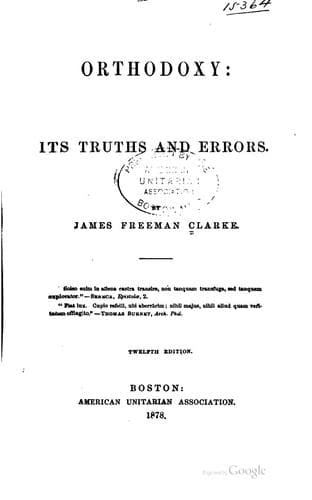
Orthodoxy: Its Truths And ErrorsClarke, James Freeman
Religion
Orthodoxy: Its Truths And Errors
Clarke, James Freeman
Unitarianism
Moreover, shall we suppose that after death we are to have no more
communion with the material universe, no more knowledge of this vast order
and beauty, which is a perpetual manifestation of God, the garment which
he wears, one of his grand methods of revelation? These myriads of suns
and worlds, these constellations of stars peopling space, this city of God
full of wonder and infinite variety, are they to be nothing to us after
the few years of mortal life are over? We cannot believe it. If, then, we
are still to perceive the material universe, the faculties by which we
perceive it will be more intense bodily faculties. If spiritual things are
spiritually discerned, bodily things are discerned in a bodily manner.
Such considerations as these show that a future bodily existence is
reasonable; but the proof of it must come, if at all, either from
revelation or experience. Let us see, then, what bearing the resurrection
of Jesus has upon this question.
According to the Gospels, Jesus rose from the dead in bodily form. This
body resembled his former one, so as to be recognized by his disciples; it
had the marks of the spear and nails; it could be touched, and was capable
of eating food. In all these respects it seems exactly the same body he
had before. This, too, is confirmed by the fact that he came from the tomb
where his body had been placed, and that this had disappeared. But, on the
other hand, many peculiarities indicate a difference; such as his not
being recognized at once by Mary in the garden, nor by the disciples
during the whole walk to Emmaus; his appearing and disappearing suddenly;
his coming through the closed doors. Again, if the body of Jesus was
exactly like that which he had before death, it is evident that he would
have to lay it aside again before ascending into the spiritual world, for
flesh and blood cannot inherit the kingdom of God. But if he was to lay it
aside again, this would be equivalent to dying a second time, which would
destroy the whole meaning and value of his resurrection, making it nothing
but a mere revival, or coming to life again, like that of a person who has
been apparently drowned. Such a revival would have produced no results,
and the faith of the Church which has come from the resurrection of Jesus
would never have taken place.
Accordingly, we must conclude that Jesus rose with a higher spiritual
body. And this gives to the ascension its meaning. For otherwise, the
ascension would be only a disappearance; whereas, in this view, the
disciples saw him pass away in the shape and form he was to continue to
wear in the other world. Then the gulf was bridged over, in their minds,
and they had looked into heaven.
Public-domain text, read in full here on John Shaqi.
Reviews
Reviews
No reviews yet
Be the first to share your thoughts on this work.
Elsewhere in the archive
Join the Discussion
Join the discussion
Sign in to leave a comment or review.
Sign InorCreate an account