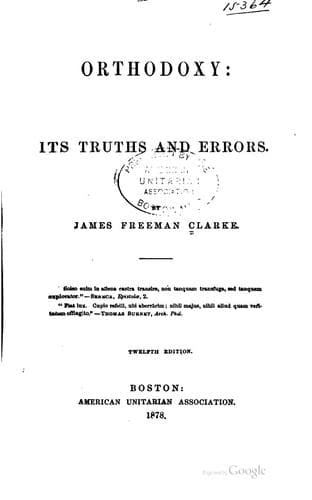
Orthodoxy: Its Truths And ErrorsClarke, James Freeman
Religion
Orthodoxy: Its Truths And Errors
Clarke, James Freeman
Unitarianism
This was what the resurrection of Jesus did for the apostles. It changed
doubt and despair into faith and hope; changed theoretical belief into
practical assurance; imparted that commanding energy of conviction and
utterance which only comes from life. Animated thus themselves, they were
enabled to animate others. And so the resurrection of Christ was the
resurrection of Christianity, the resurrection of a Christian faith and
hope infinitely deeper and stronger than had before existed in the minds
of the disciples.
We do not like the usual method of regarding the resurrection of Jesus as
a great exceptional event, and an astounding violation of the laws of
nature. Its power seems rather to have consisted in this, that it was a
glorious confirmation of those everlasting laws announced by Jesus—laws
boundless as the universe. The very essence of the gospel is the
declaration that good is not only better than evil, which we all knew
before, but stronger than evil, which we weakly doubt.
The gospel assures us that love is stronger than hatred, peace than war,
holiness than evil, truth than error. It is the marriage of the goodness
of motive and the goodness of attainment; goodness in the soul and
goodness in outward life; heaven hereafter and heaven here. It asserts
that the good man is always in reality successful; that he who humbles
himself _is_ exalted, he who forgives _is_ forgiven, he who gives to
others receives again himself, he who hungers after righteousness is
filled. This was the faith which Christ expressed, in which and out of
which he lived and acted; it was this faith which made him Christ the
King, King of human minds and hearts. Was it then all false? Did his death
prove it so? Was that the end, the earthly end, of his efforts for man?
Were truth and love struck down then by the power of darkness? That was
the question which his resurrection answered; it showed him passing
through death to higher life, through an apparent overthrow to a real
triumph; it gave one visible illustration to laws usually invisible in
their operation, and set God’s seal to their truth. Through that death
which seemed the destruction of all hope, Jesus went up to be the Christ,
the King.
In this point of view we see the value and importance of the resurrection
of Jesus, and why Easter Sunday should be the chief festival of
Christianity. It was the great triumph of life over death, of good over
evil. It was the apt symbol and illustration of the whole gospel.
Public-domain text, read in full here on John Shaqi.
Reviews
Reviews
No reviews yet
Be the first to share your thoughts on this work.
Elsewhere in the archive
Join the Discussion
Join the discussion
Sign in to leave a comment or review.
Sign InorCreate an account