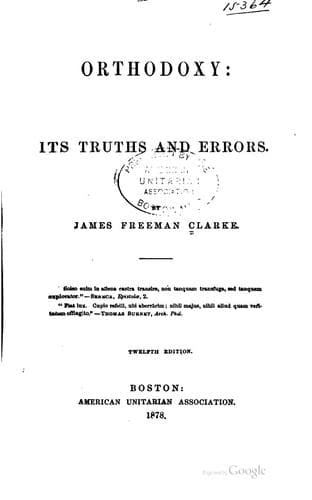
Orthodoxy: Its Truths And ErrorsClarke, James Freeman
Religion
Orthodoxy: Its Truths And Errors
Clarke, James Freeman
Unitarianism
If, then, the resurrection of Christ means that Christ ascended through
death to a higher state; if our resurrection means that we pass up through
death, and not down; not into the grave, but into a condition of higher
life; if the resurrection of the body does not mean the raising again out
of the earth the material particles deposited there, but the soul clothing
itself with a higher and more perfect organization; if it is, then, the
raising of the body to a more perfect condition of development,—then is
there not good reason why such stress should be laid upon this great fact?
All the proof rests on the historic fact of the resurrection. Was Christ
seen in this higher spiritual and bodily state, or was he not? If he was,
then we have a fact of history and experience to rely upon to show us that
the future life involves an ascent both spiritual and bodily. And this is
the reason why such stress has been laid on the resurrection.
This raising of man, through the power of Christ’s life, to a higher
state, is not a mere matter of speculation, then, not an opinion, not
something pleasant to think of and hope for, but it is a fundamental fact
of Christian faith. Because Christ has arisen and passed up, we must all
arise and pass up, too, with him. He is the first fruits of those who
sleep. In proportion as the Spirit of Christ is in us, in that proportion
is the power in us which shall carry us upward towards him. He wishes that
those who believe in him shall be where he is. We shall belong to him and
to his higher world, not arbitrarily, but naturally; not by any positive
decree of God, but by the nature of things.
The essential fact in the resurrection is, that Christ rose, through
death, to a higher state. The essential doctrine of the resurrection is,
that death is the transition from a lower to a higher condition in all who
have the life which makes them capable of it.
CHAPTER XIII. CHRIST’S COMING, USUALLY CALLED THE “SECOND COMING,” AND
CHRIST THE JUDGE OF THE WORLD.
§ 1. The Coming of Christ is not wholly future, not wholly outward, not
local, nor material.
It is a curious fact that, in direct contradiction to Christ’s own
explanations concerning his coming, this should frequently be considered
by the Orthodox, (1.) as wholly future; (2.) as wholly outward; (3.) as
local; (4.) as bodily and material.
It cannot be wholly future, for if it were, Jesus was mistaken in saying
of the signs of his coming, “This generation shall not pass away until all
these things be fulfilled.” (Mark 13:30.)
Nor can it be wholly outward, for if it were, Jesus was mistaken when he
declared of the signs of his coming, “The kingdom of God cometh not with
observation” (Luke 17:20); “The kingdom of God is within you ” (Luke
17:21); “My kingdom is not of this world” (John 18:36). See also Mark
4:26,27, and Matt. 13:33, where his kingdom is compared with seed
sprouting and leaven working secretly.
Public-domain text, read in full here on John Shaqi.
Reviews
Reviews
No reviews yet
Be the first to share your thoughts on this work.
Elsewhere in the archive
Join the Discussion
Join the discussion
Sign in to leave a comment or review.
Sign InorCreate an account