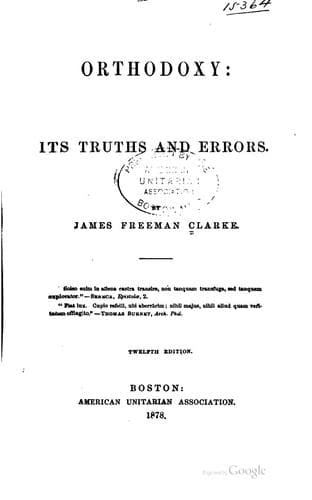
Orthodoxy: Its Truths And ErrorsClarke, James Freeman
Religion
Orthodoxy: Its Truths And Errors
Clarke, James Freeman
Unitarianism
It is often said that the apostles themselves were mistaken in expecting a
speedy coming of Christ. No doubt they did expect his speedy coming, and
with reason; for he himself had told them that the existing generation
should not pass away till all those things were fulfilled. Therefore they
were justified in looking for a near coming of Jesus as the Christ. We
admit that they expected his speedy coming; but we think they were not
mistaken, for he did come. He came, though not perhaps in the manner they
anticipated. Possibly they interpreted too literally what he said
concerning his coming.
For though Christ spoke so much in symbols and parables, literal people
took him literally. And so they do still. When he said that except men ate
his flesh and drank his blood they could not be his, the literalists said,
“_How_ can this man give us his flesh to eat?” And so many persons still
think that somehow Christ’s actual body is to be eaten in the Lord’s
supper. So, when he said that the Son of man should be seen “coming in the
clouds of heaven with power and great glory, and send his angels with the
sound of a trumpet, and gather his elect from the four winds,” they took
it literally. His apostles, even, may have supposed that he was to be seen
up in the air in physical form,(43) and that a material trumpet was to be
blown. But all this was the flesh, the garb of his thought. The spirit of
his thought only is of value; the flesh profits nothing. The apostles were
wrong in supposing—if they did suppose it—that Christ was to come in their
day in the air, in an outward physical fashion, with an outward noise,
making a great demonstration to the senses of sight and hearing. Christ
never came so, and he never will come so. The only coming of Christ
possible is spiritual coming, for Christ is spirit. He did come,
therefore, in the days of the apostles, in the great access of faith and
power in their own souls, and in the souls of those whom they converted.
He came in power and great glory, when his truth came to human minds, and
his love to human hearts. He sent his angels then, and gathered his elect
from the four quarters of the heavens. When Paul was converted, Christ
came to him; when the negro chamberlain of the Queen of Ethiopia was
converted, Christ came to him; when the people of Ephesus and Corinth,
Philippi and Rome, were converted, Christ came to them. The trumpet
sounded, but it was in their souls that it sounded; the angels summoned
the elect, but these angels were the convictions sent into their reason,
and the longings awakened in their hearts.
Public-domain text, read in full here on John Shaqi.
Reviews
Reviews
No reviews yet
Be the first to share your thoughts on this work.
Elsewhere in the archive
Join the Discussion
Join the discussion
Sign in to leave a comment or review.
Sign InorCreate an account