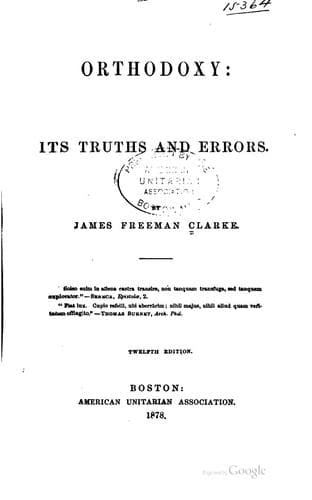
Orthodoxy: Its Truths And ErrorsClarke, James Freeman
Religion
Orthodoxy: Its Truths And Errors
Clarke, James Freeman
Unitarianism
Materialists and Literalists are always the same. The apostles soon rose
out of their literalism, and soon spoke of Christ as being revealed
_within_ them, not outside of them; dwelling, not in the air, but in their
hearts. But literalists, down to this day, have always imagined the coming
of Christ to be to the senses, rather than to the soul. They do not see
that a great noise in the air is not so glorious a thing as a voice heard
in the depths of the heart, and a great outward conflagration somehow
seems to them more imposing than the burning up of falsehood and sin in
the world. So we are always hearing people predict that Christ is to come
in 1846, or 1856, or 1866, meaning thereby that they expect some great
outward event then, visible to eyes and ears. “Fools, and slow of heart,”
not to see that the only possible coming of Him who is spirit and love is
a coming in the soul, and that he has come, and is coming, and is to come
more and more abundantly, from day to day. So they read about the heavens
and earth being burned up, and of a new heavens and earth; and they
imagine that the sky is somehow to be burned with material fire, and the
surface of the earth to sink into the flaming abyss beneath us. But if
this should happen, _that_ would have nothing to do with the coming of
Christ. The heavens and earth which he consumes with the breath of his
mouth, and destroys with the brightness of his coming, are the religions
and moralities, the institutions and works, of men. And the new heavens
and new earth which take their place are the higher, nobler, purer
religions and moralities which flow out of the Spirit of Christ.
§ 4. Examination of the Account of Christ’s Coming given by Jesus in
Matthew (chapters 24-26).
A great difficulty in regard to the coming of Christ is to combine in one
view the different notions given in Scripture concerning it. Many of these
ideas indicate that the coming of Christ took place at the destruction of
Jerusalem, as, for example, the description of wars, destruction of the
Temple, and especially the declaration that “this generation shall not
pass away till all these things be fulfilled.” On the other hand, the
coming of Christ is expressly connected, in our translation, with “the end
of the world,” and with the general judgment. Hence a difficulty in
interpreting these passages, some persons thinking that the coming of
Christ took place at the destruction of Jerusalem; others thinking that it
is yet to take place at the end of the world; others, again, maintaining
two or more comings of Christ; and others spiritualizing the whole of it,
and making it mean the spread of the spirit of Christianity.
Let us, therefore, examine the passage in which Christ’s coming is spoken
of, and endeavor to find its natural and obvious meaning, and so see how
far the common Orthodox conception is correct.
Public-domain text, read in full here on John Shaqi.
Reviews
Reviews
No reviews yet
Be the first to share your thoughts on this work.
Elsewhere in the archive
Join the Discussion
Join the discussion
Sign in to leave a comment or review.
Sign InorCreate an account