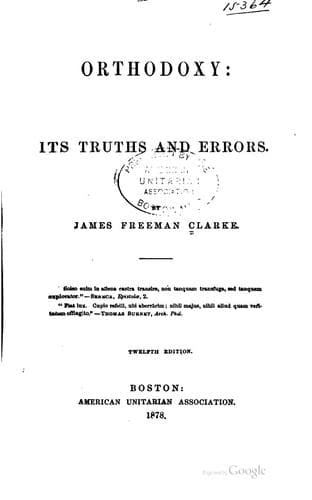
Orthodoxy: Its Truths And ErrorsClarke, James Freeman
Religion
Orthodoxy: Its Truths And Errors
Clarke, James Freeman
Unitarianism
The best way to get at the facts is to begin at the beginning, and ask
_what the disciples meant_ when they asked for the signs of Christ’s
coming. They were sitting with Jesus on the Mount of Olives, looking
across the valley between, at the Temple. They saw and admired the
gorgeous magnificence of this vast edifice towering before them, white
with marble and yellow with gold, against the deep blue sky of that sunny
land, and as they admired it, Jesus told them that every stone of that
divine structure should be cast down. And then they asked, “_When_ shall
these things be? and what shall be the signs of thy coming, and of the end
of the world?” What was the connection, in their minds, between the three
events? Why should they have at once inferred that the destruction of the
Temple was to take place at the coming of Christ, and that the coming of
Christ was to take place at the end of the world? There was no connection
at all, according to the common notions on this subject. If the coming of
Christ was to be a great outward manifestation in the sky, to take place
long after his death, after the lapse of thousands of years, and at the
destruction of the visible universe, what had that to do with the Jewish
Temple? or, indeed, what had that to do with any of their ideas concerning
their Master? But the notion in their minds, when they asked the question,
was something very different; not the present Christian idea, but the
usual Jewish idea. They spoke as Jews, out of the notions of their day.
Christ answered what was in their minds, not what is in ours. If we wish
to know what he meant, we must place ourselves on their stand-point, look
out of their eyes, and listen with their ears.
The coming of Christ had a very distinct meaning to the Jewish mind. It
meant the manifestation of the Messiah, _as such_. It meant his coming to
reign as king. It meant his manifestation in Judea, in Jerusalem, as the
great Son of David, and the submission of the Jews, and Gentiles with
them, to his authority. The disciples of Jesus, believing him to be the
Christ, believed that he was to come as such. He had come as Prophet, as
Teacher, as a worker of beneficent miracles, but he had not yet come as
Christ, as King. They were not asking about any second coming after his
death and resurrection, for they did not believe that he was to die. They
were asking for his present triumphant manifestation and investiture as
the Messiah.
Public-domain text, read in full here on John Shaqi.
Reviews
Reviews
No reviews yet
Be the first to share your thoughts on this work.
Elsewhere in the archive
Join the Discussion
Join the discussion
Sign in to leave a comment or review.
Sign InorCreate an account