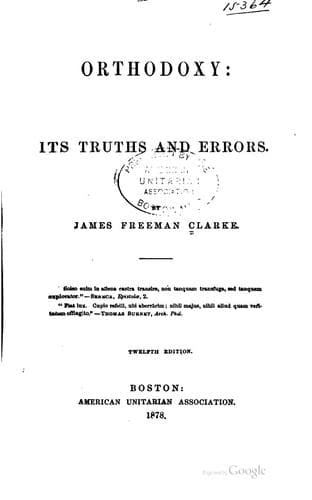
Orthodoxy: Its Truths And ErrorsClarke, James Freeman
Religion
Orthodoxy: Its Truths And Errors
Clarke, James Freeman
Unitarianism
Nor were they asking—as our translators make them ask—for “the end of the
world.” But they were asking for the _end of the age_—that is, of the
first age. We have said that the Jews divided all time into two great
periods; one the age preceding the Messiah, the other the age of the
Messiah. The first was called this age, or the present age; the other the
coming age. The end of the first period and beginning of the second were
called the ends of the age; as where Paul says, “These are written for our
admonition, upon whom the ends of the world are come;” and where he says
that Christ has “now once appeared in the end of the world to put away
sin.” These were the ideas of the Jews, as we know from history. When,
therefore, Christ spoke of the overthrow of the Temple, they inferred that
he was speaking of the beginning of the Messianic age; since the Temple
would not be overthrown while the Jewish theocratic and Levitical
government continued. Now, as the Jewish age did come to an end at the
destruction of Jerusalem, and Christianity, as the universal religion,
took the place of Judaism in the education of the human race, this really
was the coming of the Messiah and the end of the age.
We understand, therefore, Christ to have been really speaking of his
coming, as an event soon to take place, and which did soon take place,
when, at the destruction of Jerusalem, the Jewish Christians were
scattered through the world, and Christianity took its place as a
universal religion.(44) If this exhausted the meaning of the idea, it
would be of very little interest to us. But the contents of the passage
are more rich and full; and, like most of Christ’s sayings, besides its
present and immediate application, it has more universal and far-reaching
meanings. The principles of Christianity which were manifested then,
continue to be manifested in other forms to-day. Jesus said on one
occasion, “The hour is coming, and now is, when all that are in their
graves shall hear the voice of the Son of man.” And on another occasion,
“The hour is coming, and now is, when the true worshippers shall worship
the Father.” The hour had come in its first manifestation, but was to come
again in other and richer manifestations of the same principle. So Christ
himself came as King at the taking of Jerusalem, but has come since, again
and again, more plainly and fully, in other triumphs of his truth, in
other manifestations of his power. We believe that the coming of Christ
took place at the destruction of Jerusalem. We believe that it has taken
place since, in other historical events. We believe that it is to take
place more fully hereafter, in this life and in the other life.
Let us look and consider how this may be.
§ 5. Coming of Christ in Human History at different Times.
Public-domain text, read in full here on John Shaqi.
Reviews
Reviews
No reviews yet
Be the first to share your thoughts on this work.
Elsewhere in the archive
Join the Discussion
Join the discussion
Sign in to leave a comment or review.
Sign InorCreate an account