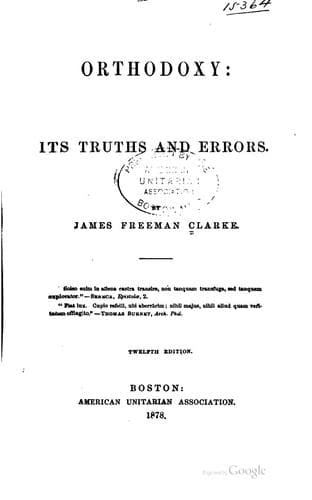
Orthodoxy: Its Truths And ErrorsClarke, James Freeman
Religion
Orthodoxy: Its Truths And Errors
Clarke, James Freeman
Unitarianism
But do we not often all do the same? Christ comes to us in the form of a
new truth, which will correct our errors and enlarge our hearts. But
loving our own little creed better than the truth, we reject it without
examination, and so judge ourselves unworthy of the light, strength, and
peace it might bestow. Christ comes again in some opportunity of
usefulness to our neighbor. But loving our own selfish ease, we excuse
ourselves, and so judge ourselves unworthy of the happiness we should
enjoy in doing the kind action. He comes in some deep conviction, calling
us to a new life. We feel that we ought to leave our frivolity, and live
for God and eternity—live for what is real and permanent. But we stifle
these convictions, and go back to our old lives, and so judge that we are
not worthy to become the friends and fellow-workers of Jesus, and
companions of the pure and good. The great feast is ready, and the
invitation is sent to us, and we, with one consent, begin to make excuse.
Do we think that in that moment we are standing before the judgment seat
of God, and pronouncing sentence on ourselves? It is our own heart that
condemns us, and God, and Christ, and the everlasting truth of things must
confirm the sentence.
§ 10. Paul’s View of the Judgment by Christ.
What were the views of the apostle Paul concerning a future judgment? One
of the passages is in Romans. (2:5-16.) In this passage Paul describes a
day, or time, when God should judge and bring to light the secrets of the
human heart. He refers probably to the coming of Christ, as described in
the twenty-fifth chapter of Matthew. Christ’s coming is represented as
“that day” the “day of judgment,” as, “it shall be more tolerable for
Sodom and Gomorrah in the day of judgment.” It was not, we have seen, as
is commonly supposed, only a judgment in the other world after death, but
also a judgment in this world. It was not when we should go to Christ in
the other world, but when Christ should come to us in this world. It is
spoken of as a particular day, or time, and, no doubt, it was thought at
first by Paul, as by the other apostles, that the coming of Christ was to
be sudden and outward—an imposing visible transaction. But, gradually,
Paul’s views on this subject changed, under the influence of a growing
spiritual insight. At first he interprets literally what Jesus says of his
coming. But afterwards, in his later Epistles to the Ephesians and
Colossians, he ceases to dwell on the outward coming, and speaks of the
inward revelation of Christ in the heart—speaks of our now sitting in
heavenly places with Christ. We may, therefore, suppose that the apostle
believed the essence of the judgment to be in this—that either in this
world or the next, or both, there shall be a revelation of God’s truth to
the soul, so that every soul shall see itself as God sees it—see its own
evil or good, and so be rewarded or punished by that sight. This idea is
Public-domain text, read in full here on John Shaqi.
Reviews
Reviews
No reviews yet
Be the first to share your thoughts on this work.
Elsewhere in the archive
Join the Discussion
Join the discussion
Sign in to leave a comment or review.
Sign InorCreate an account