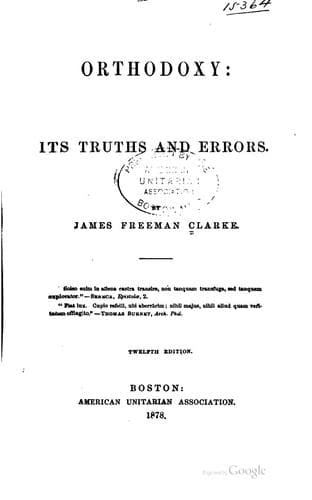
Orthodoxy: Its Truths And ErrorsClarke, James Freeman
Religion
Orthodoxy: Its Truths And Errors
Clarke, James Freeman
Unitarianism
Beside the practical motive for maintaining this doctrine, which we have
intimated, there are also scriptural and philosophical reasons. Scripture
and reason both do, in fact, seem to teach opposite doctrines on this
subject. There are passages in the New Testament which appear to teach
never-ending suffering, and others which appear to teach a final,
universal restoration. It is written, “These shall go away into eternal
punishment;” but it is also written, that Christ “shall reign till all
things are subdued unto him;” when “the Son also himself shall be subject
to Him who did put all things under him, that God may be all in all.” As
the same word is used to express the way in which all enemies are to be
subject to Christ, and the way in which Christ himself is to be subject to
God, it follows that the enemies, when subjected, shall be friends. It is
said that the wicked shall be punished “with everlasting destruction from
the presence of God;” but it is also said that “in the dispensation of the
fulness of times, God will gather in one all things in Christ, both which
are in heaven and on earth;” and “that at the name of Jesus every knee
should bow, in heaven, in earth, and under the earth; and that every
tongue should confess that Jesus Christ is Lord, to the glory of God the
Father.” It is said of the wicked, that “their worm never dies, and their
fire is not quenched;” but it is also said that “it pleased the Father,
having made peace through the blood of the cross, by Christ to reconcile
all things unto himself, whether they be things in earth or things in
heaven.” So that Scripture, at first sight, seems to teach both eternal
punishment and universal restoration.
There is a similar contradiction on this subject, if considered in the
light of pure reason. When looked at from the divine attributes, the
unavoidable conclusion seems to be, that all men must be finally saved.
For God is infinitely benevolent, and therefore must wish to save all; is
infinitely wise, and therefore must know how to save all; is infinitely
powerful, and therefore must be able to overcome all difficulties in the
way of saving all: hence all must be saved. But, on the other hand, when
we consider the subject from the position of man’s nature, an opposite
conclusion seems to follow. For man, being free, is able to choose either
evil or good at any moment; and, as long as he continues to be essentially
man, he must retain this freedom; and therefore, at any period of his
future existence, however remote, he may prefer evil to good—that is, may
prefer hell to heaven. But God will not compel him to be good against his
will (for unwilling goodness is not goodness); and therefore it follows
that there is no point of time in the infinite future of which we can
certainly say that then all men will be saved.
Public-domain text, read in full here on John Shaqi.
Reviews
Reviews
No reviews yet
Be the first to share your thoughts on this work.
Elsewhere in the archive
Join the Discussion
Join the discussion
Sign in to leave a comment or review.
Sign InorCreate an account