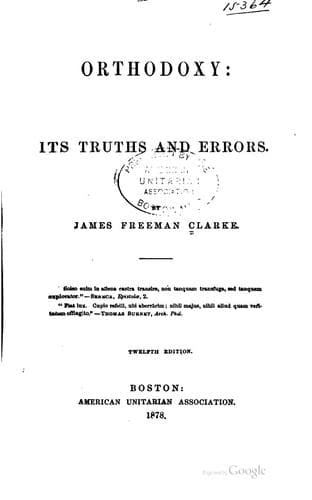
Orthodoxy: Its Truths And ErrorsClarke, James Freeman
Religion
Orthodoxy: Its Truths And Errors
Clarke, James Freeman
Unitarianism
Of course these seeming contradictions of Scripture and antinomies of
reason are not real contradictions. God does not contradict himself either
in revelation or in reason. Whether we can reconcile such antagonisms
_now_, or not, we know that they will be reconciled. Meantime, it is our
duty to disbelieve whatever is dishonorable to God, or opposed to the
character ascribed to him by Jesus Christ. Christ has taught us to regard
God as our Father. It is our duty to refuse credence to any doctrine
concerning him which is plainly opposed to this character. If I have
formed my opinion of my friend’s character from a large experience, I
ought to refuse to believe, even on good evidence, anything opposed to it.
What is faith in man, or in God, good for, that is unable to resist evil
reports concerning them? If I am told that my friend has become a thief or
a swindler, and he who tells me says, “I know that it is so—here is the
evidence,” I reply, “I do not care for your evidence. I know that it is
impossible.” So, if all the churches in the world, Catholic and
Protestant, tell me that Jesus teaches everlasting punishment inflicted by
God for the sins of this life, and produce chapter and verse in support of
their statement, I reply, “If I have learned anything about God from the
teachings of Jesus, it is that your assertion is impossible. About the
meaning of these passages you may be mistaken, for the letter killeth; but
I cannot be mistaken in regard to the fatherly character of the Almighty.”
These contradictions we shall consider in a paper printed in the Appendix
(an examination of Dr. Neheimiah Adams’s tract on the “Reasonableness of
Everlasting Punishment”). At present we will only say that we should hold
it less dishonorable to God to deny his existence than to believe this
doctrine concerning him. We think that in the last day it will appear that
the atheist has done less to dishonor the name of God than those who
persistently teach this view. For what says Lord Bacon? (Essays, XVII. Of
Superstition.) “It were better to have no opinion of God at all than such
an opinion as is unworthy of him; for the one is unbelief, the other is
contumely; and certainly superstition is the reproach of the Deity.
Plutarch saith well to that purpose. ‘Surely,’ saith he, ‘I had rather a
great deal men should say there were no such man at all as Plutarch, than
that they should say there was one Plutarch that would eat his children as
soon as they were born,’ as the poets speak of Saturn. And as the
contumely is greater towards God, so is the danger greater towards men.”
Public-domain text, read in full here on John Shaqi.
Reviews
Reviews
No reviews yet
Be the first to share your thoughts on this work.
Elsewhere in the archive
Join the Discussion
Join the discussion
Sign in to leave a comment or review.
Sign InorCreate an account