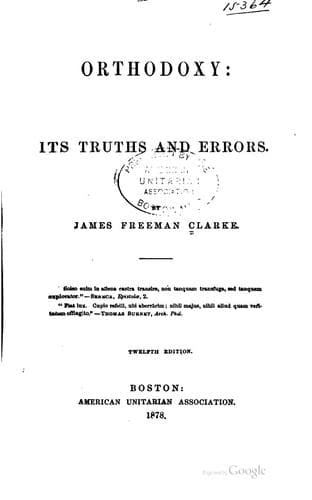
Orthodoxy: Its Truths And ErrorsClarke, James Freeman
Religion
Orthodoxy: Its Truths And Errors
Clarke, James Freeman
Unitarianism
It is certain that the doctrine of eternal punishment, in the common form,
can only be maintained by giving up some of the infinite attributes of the
Almighty. If punishment is to exist without end; if hell is always to
co-exist with heaven; if certain beings are to be continued forever in
existence merely as sinful sufferers,—then, it is clear, God is not
omnipotent. He shares his throne forever with Satan. Satan and God divide
between them the universe. God reigns in heaven, Satan in hell. God
desires that all shall be saved; but this desire is absolutely and forever
defeated by a fate greater than Deity. Law divorced from love—that is,
nature in its old Pagan aspect—is higher than God. God is not the Almighty
to any one who really believes eternal punishment. God is not the
Sovereign of the universe, but only of a part of it. The doctrine of
eternal punishment, in its common form, does, therefore, virtually
dethrone God.(49)
It is, in fact, impossible to conceive of an eternal hell co-existing with
an eternal heaven, without also seeing that it limits eternally the divine
Omnipotence; for the omnipotence of God is in carrying out his will to
have all men saved by becoming holy. Unless God’s laws are obeyed, God is
not obeyed; and he is not sovereign if not obeyed. Hell is a condition of
things hostile to God’s will: it is a permanent and successful rebellion
of a part of the universe. It is no answer to say, that it is shut up, and
restrained, and made to suffer; for it is _not_ conquered. God has
conquered sin only when he has reduced it to obedience. Hell is no more
subject to God than the Confederate States, during the rebellion, were
subject to the United States government. They were shut up by a blockade;
they were restrained by great armies and navies; they were made to suffer;
but they were _not_ reduced to submission and obedience.
Nor is it any answer to say, that the existence of sin and suffering
hereafter no more limits God’s omnipotence than their existence here and
now limits his omnipotence. For the question is of ETERNAL suffering.
Temporal suffering hereafter, we grant, is no objection to the divine
Omnipotence. Limited and finite evil, in this world or the other, is no
philosophical difficulty; and for this reason—that finite evil, when
compared with infinite good, becomes logically and mathematically _no_
evil. The finite disappears in relation to the infinite. All the
sufferings and sins of earth, through all ages, are strictly nothing when
viewed in the light of the eternal joy and holiness which are to result
from them. This is a postulate of pure reason. Make evil finite, and good
infinite,—make evil temporal, and good eternal,—and evil ceases to be
anything. But make evil eternal, as is done by this doctrine, and then we
have Manicheism—an infinite dualism—on the throne of the universe.
§ 5. Everlasting Punishment contradicts the Fatherly Love of God.
Public-domain text, read in full here on John Shaqi.
Reviews
Reviews
No reviews yet
Be the first to share your thoughts on this work.
Elsewhere in the archive
Join the Discussion
Join the discussion
Sign in to leave a comment or review.
Sign InorCreate an account