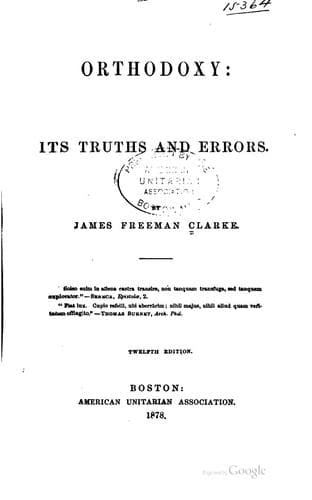
Orthodoxy: Its Truths And ErrorsClarke, James Freeman
Religion
Orthodoxy: Its Truths And Errors
Clarke, James Freeman
Unitarianism
This doctrine is a relapse on Paganism, and derived from it. It has
nothing to do with Christianity, except to corrupt it. No man was ever
made better by believing it: multitudes have been made worse. It
attributes to our heavenly Father conduct that, if done by the worst of
men, would add a shade of increased wickedness to their character. It
assumes that God has made intelligent creatures with the intention of
tormenting some of them forever. It assumes that those who are thus
created, exposed to this awful risk, are to be thus tormented, unless they
happen to pass through what is called an Orthodox conversion in this short
earthly life. God keeps them alive forever in order to torture them
forever.
The barbarity of this opinion exceeds all power of language to express. We
are accustomed to mourn over the anguish and misery that are in this
world. The problem of earthly evil has been a burden and anxiety to good
men in all times, a great question for thinkers in all ages. The only
satisfactory solution is, that it is temporary and educational; that it is
to pass away, and, in passing, to create a higher joy and goodness than
could otherwise have come. But the doctrine of everlasting punishment not
only annuls this explanation, and makes it impossible to explain earthly
evil, but adds to it a tenfold greater mystery. The fatherly character of
God disappears in Pagan darkness, in view of this horrid doctrine; for the
everlasting suffering of one human being contains in itself more evil than
the accumulated sufferings of all mankind from the creation of the world
to the end of it. Add together all the sicknesses, bereavements,
disappointments, of all mankind; all the wars, famines, pestilences, that
have tormented humanity; add to these all the mental and moral pangs
produced by selfishness and sin in all ages, and all that are to be to the
end of time,—and these all combined are logically and mathematically
_nothing_, compared with the sufferings of one human being destined to be
everlastingly punished. For all temporal sufferings added together are
finite; but this is infinite.
Now, the being who could inflict such torture as this is _not_ the God and
Father of our Lord Jesus Christ. There may be some deity of cruelty, some
incarnation of wrath and despotism, in the Hindoo Pantheon, capable of
such terrific wickedness. It is no answer to say that God inflicts
suffering now in this world, and therefore he may inflict everlasting
suffering in the other; for those are all finite; that is infinite.
_Finite_ suffering may result in greater good, may be an education to
good; but _everlasting_ suffering cannot. The finite and infinite cannot
be compared together. There is no analogy between them.
Public-domain text, read in full here on John Shaqi.
Reviews
Reviews
No reviews yet
Be the first to share your thoughts on this work.
Elsewhere in the archive
Join the Discussion
Join the discussion
Sign in to leave a comment or review.
Sign InorCreate an account