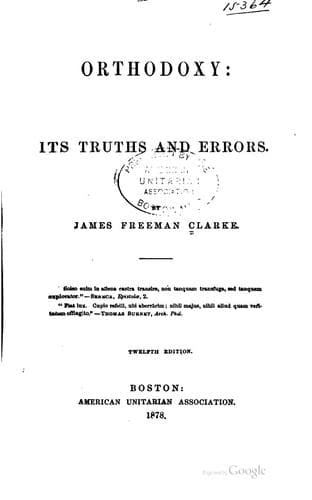
Orthodoxy: Its Truths And ErrorsClarke, James Freeman
Religion
Orthodoxy: Its Truths And Errors
Clarke, James Freeman
Unitarianism
Our object in this chapter is to consider the Orthodox view, and we shall
not, therefore, enter into any extensive argument concerning universal
salvation. We will only here indicate the general scriptural evidence in
its support. The alternative to the Orthodox view of everlasting
punishment is not, as we have shown, necessarily Universalism. It may be
annihilation, or it may be, under the name of eternal punishment, a
negative evil, being the privation of the highest kind of happiness.
Still, it seems proper to suggest, if only very briefly, some reasons
given by Universalists for their belief.
In the Epistles of Paul there are five or six passages, which appear to
teach, or to imply, an ultimate restoration of salvation of all moral
beings. Among them are these:—
1. Eph. 1:9, 10. “Having made known to us the mystery of his will,
according to his good pleasure, which he hath purposed in himself, that in
the dispensation of the fulness of times he might gather together in one
all things in Christ, both which are in heaven and which are on earth,
even in him.”
The apostle is speaking of the “riches of God’s grace,” wherein “he hath
_abounded_ toward us,” and gives as the proof this revelation made in
Christ of a great mystery—that “in the dispensation [economy] of the
fulness of times” he might bring into one (under one head) “all things in
heaven and on earth.” The idea of the passage seems evidently to be that
in the economy, or order, of the divine plan, which extends through
indefinite periods of time, all things shall be united under one head in
Christ. But if brought under one head (as the Greek word signifies), then
all become Christians, all “in heaven and earth.” This would seem to be a
very plain statement of a universal restoration.
As such, Olshausen, one of the most Orthodox of commentators, regards it.
He rejects all the explanations offered by the advocates of everlasting
punishment as unsatisfactory. “It cannot be disputed,” he says, “that in
it the restoration of all things seems to be again favored—a view which
Paul in general, as has already been remarked (on Rom. 11:32; 1 Cor.
15:24; Gal. 3:22) says more to support than the other writers of the New
Testament.” Olshausen declares the interpretations which suppose a merely
external subjection of the world to Christ to be entirely inadequate, and
have left unresolved the principal difficulty, which is, “how Paul could
say that all have a share in redemption, if he held the common view that
the numberless hosts of angels who fell, along with the far greatest part
of mankind (Matt. 7:13, 14) are eternally damned, and thus shut out from
the harmony of the universe.” The defenders of universal restoration, says
Olshausen, “understand the harmony of the universe seriously, in its
literal meaning, and seem, according to that, to be here in the right.”
Public-domain text, read in full here on John Shaqi.
Reviews
Reviews
No reviews yet
Be the first to share your thoughts on this work.
Elsewhere in the archive
Join the Discussion
Join the discussion
Sign in to leave a comment or review.
Sign InorCreate an account