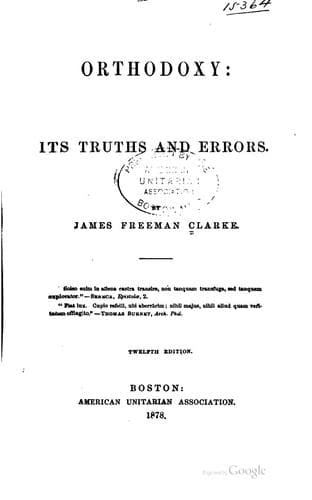
Orthodoxy: Its Truths And ErrorsClarke, James Freeman
Religion
Orthodoxy: Its Truths And Errors
Clarke, James Freeman
Unitarianism
This view of the final results of moral evil, as destroying personal
existence, is hardly an Orthodox doctrine, though quasi-Orthodox. It is
the refuge of that class of minds which are unable to accept universal
restoration on the one side, or everlasting punishment on the other. To
them a large number of human beings seem “too good for banning, and too
bad for blessing,” and in their opinion will be suffered quietly to drop
out of conscious existence. The analogies of nature, in which out of many
seeds and many eggs produced, only a few attain to the condition of plants
and animals, tend to confirm this view. The state of human character here
appears also to favor it, since multitudes pass out of this world in an
undeveloped condition, seeming wholly to have failed of the end of their
being. The chief scriptural argument in favor of the doctrine is found in
the assumption that “life through Christ” is equivalent to continued
conscious existence, and that “death” as the punishment of sin, is
equivalent to annihilation. We have so fully discussed the meaning of
these terms in the previous chapter, that it is not desirable to argue
this point here. We agree with the Orthodox view, and differ from that of
the annihilationists on this point. The God of the gospel is the Father of
all his children—of the weakest, feeblest, and most sinful. If he is the
God of _all_, then he is “the God, not of the dead, but of the living, for
all live to him.” Indian tribes and heathen nations may be willing that
the sickly infants, and those worn with age, should perish; they may
expose female infants, thinking them not worth bringing up; but Christian
nations establish schools and hospitals for the deaf and dumb, the insane,
the inebriates, the idiotic. If we, then, being evil, know how to care for
the weak, undeveloped, and vegetative natures, how much more shall their
Father in heaven care for them! The doctrine of annihilation rests
fundamentally on a Pagan view of God.
§ 10. The Doctrine of Universal Restoration.
This opinion has its roots, we think, in the gospel. It has prevailed in
the church from the earliest times, having been held, as we have seen, by
Origen, and a great number of eminent church fathers and doctors. What
more Christian word has come to us from the earliest centuries than the
cry out of the heart of the great Alexandrian teacher, “My Saviour, even
now, mourns for my sins. My Saviour cannot be happy while I remain in my
iniquity. He does not wish to drink the cup of joy alone in the kingdom of
God; he is waiting till we shall come and join him there.”(59)
Public-domain text, read in full here on John Shaqi.
Reviews
Reviews
No reviews yet
Be the first to share your thoughts on this work.
Elsewhere in the archive
Join the Discussion
Join the discussion
Sign in to leave a comment or review.
Sign InorCreate an account