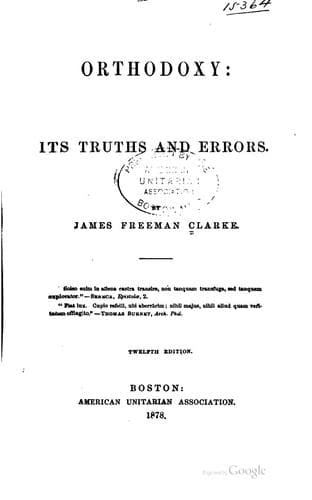
Orthodoxy: Its Truths And ErrorsClarke, James Freeman
Religion
Orthodoxy: Its Truths And Errors
Clarke, James Freeman
Unitarianism
It is scarcely necessary to discuss here the abstract question—Is a church
an essential want of man, so as to be needed by him forever? It is enough
to show that a church is needed now, and will be, for a long time to come.
Every religion has had its church. No sooner does a new idea arise, than
it is incorporated in some outward union. The new wine is put into new
bottles. Confucius has his church, Mohammed has his church; even Mormonism
and Spiritualism have established their churches. The Christian Church
arose immediately after the ascension of Jesus; it came as a matter of
necessity, born not of flesh, nor of the will of man, but of God. It has
continued ever since, in ever-varying forms, but one undying body. Other
institutions have risen and passed away. The Roman empire has disappeared.
The barbarous nations overflowed Europe, and then were civilized,
Christianized, and absorbed into the Christian Church. Protestantism
separated from Romanism, but _the Church_ remained in both. Other sects,
Presbyterian, Independent, Quaker, Methodist, Baptist, Swedenborgian,
Unitarian, Universalist, separated from the main Protestant body, but each
took with it the church; each has its own church. Even the Quakers, the
most unchurched apparently of any, who renounced the visible ministry, and
the visible sacraments, made themselves presently into the most compact
church of all. So the word continues evermore to be made flesh. So all
spirit presently becomes incarnate in body. The body is outward and
visible; the spirit inward and invisible. Both are necessary to the life,
growth, and active influence of the gospel. Without the spirit of
Christianity, the body would be good for nothing; it would be only a
corpse. Without the body of Christianity, the spirit would be
comparatively inactive; it would be only a ghost. A body without spirit
corrupts and is offensive; a spirit without body is inoperative and
alarming. Through body alone the spirit can act; through spirit alone the
body can live.
Public-domain text, read in full here on John Shaqi.
Reviews
Reviews
No reviews yet
Be the first to share your thoughts on this work.
Elsewhere in the archive
Join the Discussion
Join the discussion
Sign in to leave a comment or review.
Sign InorCreate an account