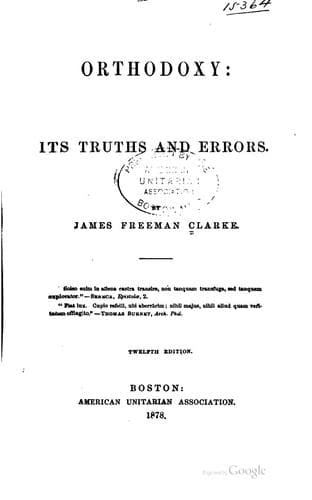
Orthodoxy: Its Truths And ErrorsClarke, James Freeman
Religion
Orthodoxy: Its Truths And Errors
Clarke, James Freeman
Unitarianism
Without asking, therefore, for any other authority for the Church, than
its adaptation to human wants, we may safely say, that it is a great
mistake to suppose we can dispense with churches. You cannot overthrow the
churches, not the weakest of them, by any agency you can use; for all came
up to meet and supply a want of the human soul. They are built on that
rock. What will you put in their place? A lyceum? A debating society? A
reform club? What are you to say to the souls of men, hungering and
thirsting for God? What to the sinner, borne down by the mighty weight of
transgression? What to the dying man, who knows not how to prepare to meet
his God? We need the Church of Christ—the Church whose great aim it is,
and always has been, to renew and regenerate the soul from its foundation,
to lay the axe at the root of the tree of evil, and the very sound of
whose bell, rolling its waves of music over the sleeping hills on the
Sabbath morning, is worth more to the soul than a thousand lyceums and
debating societies.
No; the Church is not to be destroyed; it is to be renewed with a deeper
and fuller life. We want a better Church, no doubt—one more free in its
thought, more active in its charity, with more of brotherhood in it. We
want an apostolic Church, fitted to the needs of the nineteenth century.
The theological preaching which satisfied our parents is not what we wish
now. We need Christianity applied to life—the life of the individual and
of the state. A better Church, no doubt, is needed; but we want the
churches _fulfilled_, not destroyed.
§ 2. Orthodox Doctrine of the Church—Roman Catholic and High Church.
Admitting, then, the permanency of the Christian Church, we next ask,
“What is its true form?” or, “Which is the true Church?” or, again, to
state it in another way, “Is the form of the Church permanent, or only its
substance? Is _any_ union for Christian purposes, for worship and work, a
Church, or must it be found in some particular organic form?” To this
question Romanism and High Church Episcopacy reply, “It must.” The rest of
Protestantism answers, “No.” Romanism says—Jesus established an essential
form for his Church, as well as an essential substance. The true Church is
an organization as well defined as any corporation for secular purposes.
It has the monopoly of saving souls, a patent right of communicating
spiritual life, which cannot lawfully be infringed by any other
corporation. This right was originally bestowed on St. Peter, and has been
transmitted by him to his successors, bishops of Rome. The proof is in the
original deed of gift, “Thou art Peter,” &c., and in the regularity of the
succession of subsequent bishops.
Public-domain text, read in full here on John Shaqi.
Reviews
Reviews
No reviews yet
Be the first to share your thoughts on this work.
Elsewhere in the archive
Join the Discussion
Join the discussion
Sign in to leave a comment or review.
Sign InorCreate an account