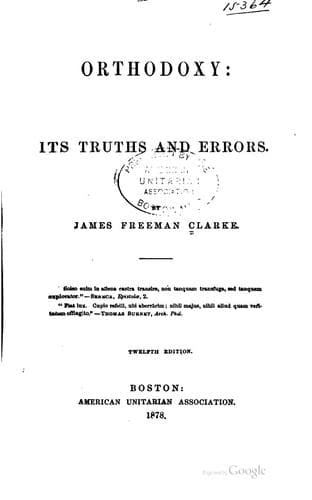
Orthodoxy: Its Truths And ErrorsClarke, James Freeman
Religion
Orthodoxy: Its Truths And Errors
Clarke, James Freeman
Unitarianism
In a little work lately published in France by the Protestant Pastor, Mr.
Bost,(65) the author gives as a reason for not being a Catholic, that
while the Church calls on us to submit to its authority, it cannot tell
where the authority resides.(66) The Ultramontanes place it in the person
of the pope; but the Gallicans have never admitted this idea, and place
the supreme authority in a universal council.
Besides, what sort of infallibility is that which has tolerated the
Inquisition, applauded the St. Bartholomew massacre, preached crusades
against the heretics in France, massacred the Protestants in Holland,
burned ten thousands at the stake in Spain? If it be said that Protestants
also have persecuted, we reply, that they did it _against_ their own
principles, but that the Catholics persecuted in accordance with theirs;
and that the Church which claims exclusive infallibility and holiness has
no right to excuse itself _because it has done no worse_ than those which
it denounces as being in error and sin.
§ 3. The Protestant Orthodox Idea of the Church.
Protestantism does not claim for its Church exclusive holiness or
infallibility. It defines the Church to be “a congregation of faithful
men, in which the pure word of God is preached, and the sacraments duly
administered.”(67) Why, then, the reaction towards Romanism? It is partly
owing to the passive element in man—the wish to be governed, the weariness
of independent thought, which led Wordsworth to say,—
“Me this unchartered freedom tires,”—
and which, in “Van Artevelde,” declares that,—
Thought is tired of wandering through the world,
And homeward fancy runs its bark ashore,—
and partly because the Protestant Churches are often less active and
diligent in the practical part of Christian work than the Roman Catholic
Churches. Instead of a manly Protestantism, they give us a diluted
Catholicism. They insist on a creed which has neither antiquity nor
authority to recommend it, on sacraments that are no real sacraments, but
only symbols, and on a ritual which has neither the beauty nor variety of
the Roman worship.
What does the Protestant Church propose to itself as its end? To produce
an abstract piety, instead of a concrete piety—not a piety embodied in
life and conduct, but taking only the form of an inward experience. If the
churches should set themselves the work of feeding the hungry and clothing
the naked, of removing the vices and crimes of men, of helping the
outcasts and visiting the prisoners, they would have a more living piety
growing out of this active charity. Their prayer meetings would be much
more vigorous when they prayed in order to work, than when they pray in
order to pray. Men should not be admitted into the Church because they are
pious, but in order to become pious by doing Christian work. By loving,
practically, the brother they have seen, they would come to love God, whom
they have not seen.
Public-domain text, read in full here on John Shaqi.
Reviews
Reviews
No reviews yet
Be the first to share your thoughts on this work.
Elsewhere in the archive
Join the Discussion
Join the discussion
Sign in to leave a comment or review.
Sign InorCreate an account