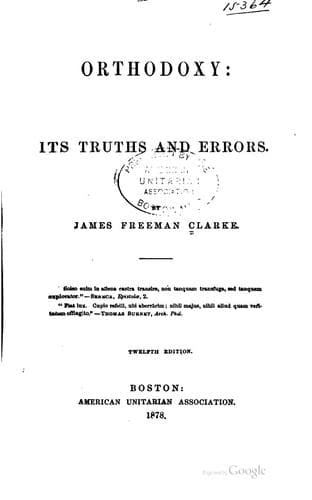
Orthodoxy: Its Truths And ErrorsClarke, James Freeman
Religion
Orthodoxy: Its Truths And Errors
Clarke, James Freeman
Unitarianism
Again: the Protestant Church feebly imitates the aristocracy of the Romish
Church. In order to conquer Romanism, we must go on and leave it behind,
seeking something better, and finding some more excellent way. Now, the
sin of Romanism is its aristocracy; Protestantism ought, then, to give us,
in its Church, a Christian democracy. But it keeps up the pernicious
distinction between clergy and laity, making the clergy a separate class,
and so justifying Milton’s complaint that the “Presbyter is only the old
priest written large.” It makes a distinction between men and women in the
Church, not encouraging the latter to speak or to vote. It makes a
distinction between the rich and poor, selling its pews to those who can
buy them, and leaving those who are unable to do so outside of the
sanctuary. It makes a distinction between Orthodox and heretics, excluding
the latter, instead of inviting them in where their errors might be
corrected. And finally, it makes an unchristian distinction between good
people and bad people; for while Jesus, its Master, made himself the
friend of publicans and sinners, the Church too often turns to them the
cold shoulder, and leaves them to be cured by the law, and not the gospel.
The following saying of a saint of the desert, Abbot Agatho, is reported
by Dr. Newman, who tells it as something wise and good. It seems to us to
illustrate, with much _naïveté_, the tendency of both Catholic and
Protestant Orthodoxy, to put right opinion above right conduct.
“It was heard by some that Abbot Agatho possessed the gift of
discrimination. Therefore, to make trial of his temper, they said to him,
‘We are told that you are sensual and haughty.’ He answered, ‘That is just
it.’ They said again, ‘Are you not that Agatho who has such a foul
tongue?’ He answered, ‘I am he.’ Then they said, ‘Are not you Agatho _the
heretic_?’ He made answer, ‘No.’ Then they asked him why he had been
patient of so much, but would not put up with this last. He answered, ‘By
those I was but casting on me evil; but by this I should be severing me
from God.’ ”
According, therefore, to Agatho and Dr. Newman, the tongue “which is set
on fire of hell,” does not separate us from God, but an error of opinion
does. Pride, “which comes before a fall,” and sensuality, which makes of a
man a beast, do not come between the soul and God so much as an honest
error of opinion.
Public-domain text, read in full here on John Shaqi.
Reviews
Reviews
No reviews yet
Be the first to share your thoughts on this work.
Elsewhere in the archive
Join the Discussion
Join the discussion
Sign in to leave a comment or review.
Sign InorCreate an account