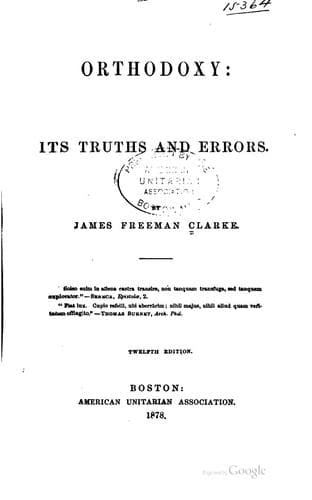
Orthodoxy: Its Truths And ErrorsClarke, James Freeman
Religion
Orthodoxy: Its Truths And Errors
Clarke, James Freeman
Unitarianism
The Protestant Church fails to overcome the Catholic Church only by being
too much like the latter. With Protestant ideas, we have semi-Catholic
Churches. We claim as our fundamental principle the right of private
judgment, and then denounce and exclude those who differ from us. We claim
that the soul is not to be saved by monkish seclusion, by going away from
the world; and yet we do not preach and carry out in our church-action the
purpose of saving the bodies of men as well as their souls. When the
Protestant Church work gets more into harmony with Protestant ideas, we
shall then see fewer relapses into Romanism.
§ 4. Christ’s Idea of a Church, or the Kingdom of Heaven.
The Roman Catholics having made the visible Church, or outward Christian
community, the central idea of Christianity, and having changed this into
a close corporation of priests, it was natural, perhaps, that Protestants
should go too far in another direction. Accordingly, the central idea in
Protestantism is not the Church, but the salvation of the soul; not
social, but personal religion; not the Christian community, but personal
development; not the kingdom of heaven here, but heaven in a future life.
Yet it is true, and has been shown lately with great power,(68) that the
direct and immediate object of Jesus was to establish a community of
believers. This was implied in his being the Christ,—for the Christ was to
be the head of the kingdom of heaven,—and the kingdom of heaven was to be
an earthly and human institution. Jesus took the idea of the kingdom of
God, as it was announced by the prophets; purified, developed, deepened,
and widened it; and it resulted in his varied descriptions of the “kingdom
of heaven,” This phrase, in the mouth of Jesus, expresses essentially what
we mean by “the Church.” This will appear more plainly if we sum up the
principal meanings of the phrase “kingdom of God” in the New Testament. It
is,—
1. _Something near at hand._
Mark 1:15. “The kingdom of God is at hand.” Luke 9:27. “There are some
standing here who shall not taste of death till they see the kingdom of
God.” Mark 9:1. “There be some of them which stand here which shall not
taste of death till they have seen the kingdom of God come with power.”
2. _It was already beginning._
Luke 17:20. “And when he was demanded of the Pharisees when the kingdom of
God should come, he answered them and said, The kingdom of God cometh not
with observation, neither shall they say, Lo, here! or, Lo, there! for
behold, the kingdom of God is within (or ‘among’) you.”
3. _It was not of this world._
John 18:36. Jesus said, “My kingdom is not of this world.”
4. _But was to be in this world._
Matt. 6:10. “Thy kingdom come, thy will be done on earth, as it is in
heaven.”
5. _In some respects it was to be an outward and visible kingdom, or an
outward institution._
Parable of the grain of mustard-seed. Matt. 13:31, 32.
6. _It would contain good and bad._
Parable of the net. Matt. 13:47.
Public-domain text, read in full here on John Shaqi.
Reviews
Reviews
No reviews yet
Be the first to share your thoughts on this work.
Elsewhere in the archive
Join the Discussion
Join the discussion
Sign in to leave a comment or review.
Sign InorCreate an account