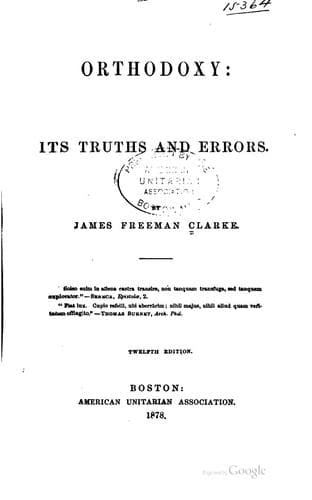
Orthodoxy: Its Truths And ErrorsClarke, James Freeman
Religion
Orthodoxy: Its Truths And Errors
Clarke, James Freeman
Unitarianism
If we study the nature, organization, and character of the primitive
Christian Church, as it appears in the book of Acts and in the Epistles,
we recognize easily the warm, loving life which was in its spring time,
when all buds were swelling, and all flowers opening. It was far from
being a perfect Church. It had many errors, and included many vices. Some
persons in the Church did not believe in the resurrection of the dead. (1
Cor. 15:12.) Some disciples had not heard there was a Holy Ghost. (Acts
19:2.) Some even became intoxicated at the Lord’s Supper. (1 Cor. 11:21,
ὁς δὲ μεθύει). Some Christians had to be told not to steal (Eph. 4:28);
nor to lie, (Col. 3:9); nor to commit other immoralities. Peter (supposed
to be the infallible head of the Church) was rebuked by Paul for
dissimulation. Paul and Barnabas could not get along together, but
quarrelled, and had to separate. Part of the Church Judaized, and
denounced Paul as a false apostle. Another part Paganized, and carried
Pauline liberty into license. And yet, though there was so little of
completed Christian character, there was a great amount of spiritual life
in the apostolic Church. They are styled saints, but never was anything
less saintly than the state of things in the beginning. But they were
looking the right way, and going in the right direction. They were full of
faith, zeal, enthusiasm, and inspiration; so they had in themselves the
promise and expectation of saintship, if not its reality.
Directly after the ascension of Christ, and the wonderful experiences of
the day of Pentecost, we find the Christian community in active operation.
Its organization was as yet very indefinite; that was to come by degrees.
It was a Church without a creed; its only creed was a declaration of faith
in Jesus as the Christ, the Son of God. It was a Church without a bishop,
or a single head of any kind; for Peter, James, and John seem all three to
have possessed an equal influence in it, and that influence was derived
from their character. Paul tells us expressly, in the Epistle to the
Galatians, that when he went up to Jerusalem, long after his conversion,
Peter, James, and John “seemed to be pillars” there. No mention is made
anywhere in the book of Acts of a single bishop presiding over the Church
at Jerusalem, or over any other Church. And as to the Romish Church, which
claims to be the oldest Church, and the mother of all the rest, it was not
yet founded at all, when the Church at Jerusalem was established. Nor was
the Church at Rome as old as the Churches at Antioch, at Lystra, at
Iconium, and elsewhere, for Paul and Barnabas ordained elders in all these
churches, as we are expressly told in Acts 14th; and in Acts 15:7 we find
Peter still at Jerusalem. If there was any church at Rome, Peter was not
its bishop; then either it was a church without a bishop, or Peter was not
its first bishop.
Public-domain text, read in full here on John Shaqi.
Reviews
Reviews
No reviews yet
Be the first to share your thoughts on this work.
Elsewhere in the archive
Join the Discussion
Join the discussion
Sign in to leave a comment or review.
Sign InorCreate an account