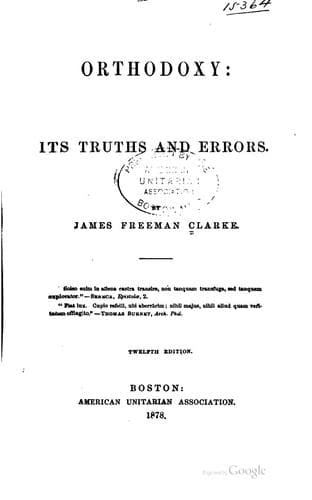
Orthodoxy: Its Truths And ErrorsClarke, James Freeman
Religion
Orthodoxy: Its Truths And Errors
Clarke, James Freeman
Unitarianism
We find also that as the apostolic Church had no creed and no bishop,
neither had it any fixed or settled forms. Its forms and usages grew up
naturally, according as convenience required. Thus (Acts 6:1-5) we find
that the apostles recommended the disciples to choose seven persons to
attend to the distribution of charity. “A murmuring arose” because the
Greek widows were neglected—neglected, probably, because not so well known
as the others. This shows that there were no fixed, established forms;
even the order of deacons was originated to meet an occasion.
That they had no form of service, no fixed Liturgy, in the apostolic
Church, appears from 1 Cor. 14:26. “How is it, brethren, when ye come
together, every one of you hath a psalm, a doctrine, a tongue, a
revelation, an interpretation? Let the prophets speak, two or three, and
the others judge, and if anything be revealed to another that sitteth by,
let the first hold his peace. You may all prophesy one by one, that all
may learn, and all be comforted.” Now, it is very evident no fixed or
formal service could have been established in the churches when he
recommended this.
But though the apostolic Church had neither bishop, nor creed, nor fixed
forms, nor a fixed body of officers, it had something better—it had faith
in God, and mutual love. “The multitude of them that believed were of one
heart and one soul; neither said any man that aught that he possessed was
his own, but they had all things common.” We do not find an absolute
community of property established by a law of the Church, as in the
monastic orders, or as in the school of Pythagoras, and some modern
communities, as that of St. Simon; for Peter says to Ananias, of his
property, “While it remained, was it not thine own? and after it was sold,
was it not in thine own power?” But though their property was in their own
power, they did not call it their own, or consider it so; it belonged to
God: they were only stewards, and they readily brought it, and gave it to
the use of the Church.
The apostolic Church was a home of peace and joy. Whatever tribulations
they might have in the world, when they met together they met Christ, and
ate their meat with gladness and singleness of heart. They were in an
atmosphere of love and freedom. We hear of no rules, no laws, no
constraining forms; but all were led by the Spirit of God. Even in their
public service, as we have seen, though Paul recommended a greater order,
it was not based on authority, but on the sense of propriety of each
individual, because God was not the God of confusion, but of peace.
Public-domain text, read in full here on John Shaqi.
Reviews
Reviews
No reviews yet
Be the first to share your thoughts on this work.
Elsewhere in the archive
Join the Discussion
Join the discussion
Sign in to leave a comment or review.
Sign InorCreate an account